Русский
The Best Countries to Launch Your iGaming Business in 2026

Before you even think about opening your online gambling brand, you need to decide where you’re going to get your license and who you’re going to accept as players. Some countries only issue licenses for local players, while others like Curaçao or Anjouan serve markets without local rules in place. For most new brands, the ideal country is one where the fixed costs and tax are low enough to leave a bit of wiggle room in the first couple of years.
This guide compares five local license markets with the key license hubs, and then explains the order of work. Every option starts with a technical decision: are you going to hold your own license or run under a provider’s license? Part of our NuxGame legal services includes company registration and license application files.
Key takeaways
-
Getting a single SPA authorization in Brazil's iGaming sector costs R$30 million and covers up to three brands - a real bonus for multi-brand groups.
-
A Kahnawake or Tobique license doesn't give you the right to accept players in markets with their own licensing system, like Brazil or Ontario.
-
Local payment rules shape the cashier, and Brazil bans credit cards and crypto for betting deposits.
-
Brazil's tax on gross revenue goes up by one point a year until it hits 15% in 2028, so we've factored that into our plans.
The iGaming Launch Process: License Hub vs Target Market
In the land-based gaming industry, a casino serves players on its own premises, so one local license covers the whole business. But online, legal requirements follow the players’ location at the moment they gamble, wherever the company is registered. That’s why the licensing rules in each market decide where a brand can accept players.
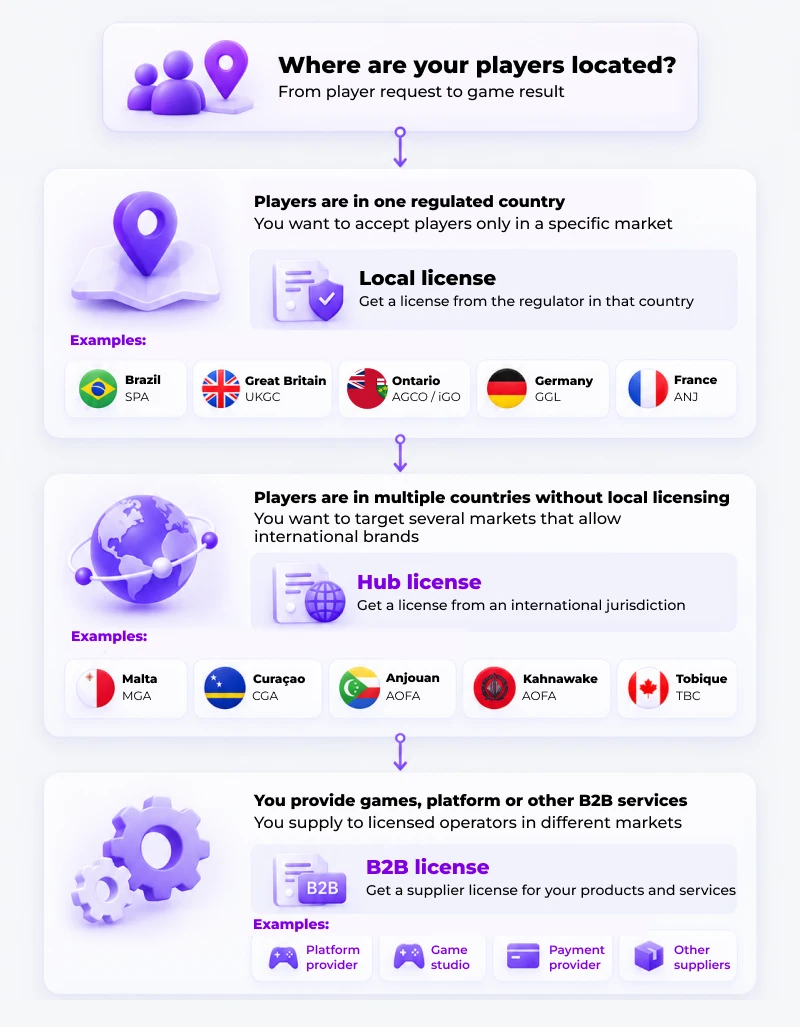
Three types of permission cover most setups in the iGaming industry:
- Local license: issued by the regulator in the country where the players are, like Brazil’s Secretariat of Prizes and Bets (SPA), before you even accept them as players.
- Hub license: issued by a regulator that serves international brands, like the Malta Gaming Authority (MGA) or the Curaçao Gaming Authority (CGA). It covers markets without a licensing system of their own, where local law lets you operate.
- B2B license: a business-to-business license held by suppliers like the platform and the game studios.
A hub gambling license is cheaper, but it only serves a smaller list of markets each year as countries like Peru and Finland start building their own local licensing systems. Without the local license, a gambling business that takes players from a regulated market risks getting blocked payments and having its site shut down.
The Top Countries for Starting an iGaming Brand: Five Local Markets
Reports on the global online gambling market show you where player spending is highest. The table shows what a new brand pays in five local license markets, and which rule shapes their offer.
| Market | License route | Tax or revenue share | Rule that shapes the offer | Source |
|---|---|---|---|---|
| Brazil | SPA authorization: R$30 million for five years, up to three brands | 13% of gross revenue, rising to 15% by 2028 | Deposits only by Pix (instant bank payment), bank transfer, debit card, or prepaid card | Law 14,790/2023; SPA/MF Ordinances 615 and 827; Complementary Law 224/2025 |
| Great Britain | UK Gambling Commission (UKGC) license, with separate types per activity | 40% Remote Gaming Duty (tax on profits from online games); most remote betting at 25% from April 2027 | Maximum bet of £5 per spin on online slots, or £2 for ages 18 to 24 | HM Treasury; UKGC |
| Ontario (Canada) | Registration with the Alcohol and Gaming Commission of Ontario (AGCO) and an agreement with iGaming Ontario (iGO) | About 20% of revenue kept by iGO, as reported | Players must be in Ontario when they place a bet | AGCO; Covers |
| Peru | Authorization from MINCETUR, the trade and tourism ministry, under Law 31557 since February 9, 2024 | 12% of net monthly income (bets minus prizes and refunds) | One license system for remote games and remote sports betting | Law 31557; CMS |
| Finland | License from a new national authority; applications are open | Applies once the market opens | Licensed market opens on July 1, 2027, when the monopoly of Veikkaus, the state-owned operator, ends | Veikkaus |
Great Britain is a good example of the trade-off between size and margin. In 2025/26, its online sector produced £8.3 billion of the British gambling industry’s gross gambling yield (GGY, stakes minus winnings paid). That was an annual growth rate of 6.9%, according to UKGC industry statistics. The new duty and the slot stake limits will decide how much of that yield a new brand gets to keep.
License Hubs for an Online Casino or Sportsbook
Newcomers to the iGaming scene often kick off under a hub license, as the fees for these are generally lower than what you’d typically find in local areas. Just how much the hubs differ is where things get really interesting – particularly when it comes to the cost and level of scrutiny they bring.
- The Malta Gaming Authority (MGA): A relatively modest €5,000 to apply for a B2C license, which lets you serve players directly. It’s then a yearly fee of €25,000 after that.
- Curaçao: They offer a pretty straightforward process for getting a direct license from the CGA. The cost is roughly €47,450 a year for a B2C license.
- The Isle of Man: The cost to apply for a full license from the Gambling Supervision Commission here is £5,250. You also have to factor in a yearly fee of £36,750, and player accounts and games have to be hosted on servers on the island.
- Gibraltar: You’re looking at a £30,000 application fee, along with a minimum of £50,000 per year for each type of activity. On top of that, you’ll need to have a real local presence here.
- Kahnawake: If you’re looking to get an operator license from the Kahnawake Gaming Commission in Quebec, Canada, that’ll set you back US$35,000 for the first year, rising to US$40,000 from 2027.
- Tobique: A license from the Tobique Gaming Commission in New Brunswick, Canada comes with a pretty big caveat: you’ll have to block players from the US and the UK.
- Anjouan (Comoros): This one is a bit of an outlier – the cost to get a license is roughly €17,800, and it’s a flat rate each year after that. You only need to get one license for casino and sports betting.
- Costa Rica: A bit of a red flag here: the municipal business license they offer isn’t accepted by payment providers as a legitimate license for games of chance.
Each hub also comes with some additional costs you’ll need to factor in beyond the annual fee. For example, the compliance contribution in the MGA fee guidance is a yearly charge that grows with revenue. This comparison of international licenses should give you a good idea of how server and staff rules can change the platform setup.
iGaming Business Model: To Build the Platform or Buy It
When it comes to launching an iGaming business, you’ll need to factor in two budgets: your fixed costs (like the license and platform) and your variable costs (tax, for one). The platform model really decides that split, so it’s the next big cost decision after the license.
The Platform Model Breakdown
| Model | What the brand owns | Main cost | Typical fit |
|---|---|---|---|
| Own build | Code, data, and every integration | Developers and certification of each integration | Groups with a large budget and time |
| White label | Brand and marketing; the provider holds the license and runs the casino platform | A share of revenue paid to the provider | A startup testing one hub market |
| Turnkey iGaming launch | Brand, license, and player data; the provider runs the platform | Setup and monthly platform fees | Brands with their own license |
White label solutions often work under hub licenses because local regulators like the SPA license the company that serves players. An iGaming software provider that’s already got local payment methods and studios connected cuts the integration work in each new market.
The other option – building your own online casino software – means repeating that work every time. A bought setup, on the other hand, means the platform provider maintains each third-party connection after opening day. The platform architecture basics should give you a good idea of how the wallet connects to games and payments.
In the NuxGame turnkey platform, you can run your casino and sportsbook together or separately, and pick studios like Evolution for live table games. The payment list includes a mix of Visa, Mastercard, Skrill, and bank transfer. And, of course, the license is all yours.
Player Checks and Payments: What Changes by Market
KYC (know your customer) checks are all about verifying player identity and age. AML (anti-money laundering) rules take that a step further and check where the money’s coming from. Regulatory requirements set the timing, so one platform will run a different check sequence in each market. The privacy policy will also change, as it needs to name where that data is stored.
Payment rules are where the real variations kick in – and you’ll see a big difference when it comes to local payment methods in the cashier (the payment page) that can help build trust at the first deposit:
- Instant bank payments: Think Pix from Brazil’s central bank.
- Cards: Visa and Mastercard, which bring card security duties with them.
- E-wallets: Stored-value accounts like Skrill that make payments a breeze.
- Crypto: Some brands under hub licenses offer it, but it’s banned for betting deposits in Brazil.
PCI DSS v4.0.1, the card industry’s data security standard, applies to every company that handles card data – as the PCI Security Standards Council puts it. It also covers any systems that can affect card data, so a brand that sends card entries to a compliant payment provider will always be a bit safer.
When a client names a new market, we start with the cashier and only then look at the license. If players in that market pay by Pix or local bank transfer, those methods have to work from the first day. A player who can't deposit in a familiar way rarely comes back. It's tax and license costs that then decide whether the margin holds.

Denis Kosinsky
Chief Product Officer at NuxGame
Pro tip: Before your iGaming business goes live, run one real deposit and one real withdrawal through every local payment method – so your support team sees every status a player sees.
Starting An iGaming Business in a New Country: A Step-By-Step Guide
A successful iGaming entry is all about getting your costs locked in as early as possible, so mistakes don’t end up costing you an arm and a leg. This guide takes you through the process, in order – which happens to be the order in which those costs become fixed:
- Market Research: Compare each target market based on how much revenue is left over after tax and fixed costs, and keep an eye on market trends by checking out the regulator’s stats.
- Business Plan: Make sure you’ve got a solid business plan in place that covers your fixed costs, tax, for at least two years and also sets a revenue level where your brand breaks even.
- Company and License: Register your company where the license requires it, then go and apply to each market’s regulator.
- Platform & Games: Connect up casino games and a sportsbook that will appeal to your target market’s tastes.
- Payments and Checks: Get your local payment methods set up and make sure any identity checks are run at the right time – according to each regulator’s rules.
- Responsible Gambling Tools: Get deposit limits and self-exclusion (i.e. a player can block their account) in place before the first deposit is even made.
- Marketing Strategies: Plan out your campaigns in a way that sticks to local ad rules, and get an affiliate program set up, which pays partner sites for every player they send your way.
- Customer Support: Make sure you’ve got staff in place who speak the local language before opening day.
Stuff like bonus offers and loyalty programs come later, once you’ve got real player data to work with and you know what keeps people coming back for more. Launching an online casino is a whole other story, covered in our infrastructure guide. If you’re launching a product in a second market, you’ll likely be reusing a lot of the work you did first time round, with just some new research and a new license application.
Common Mistakes To Avoid When Choosing The Right Country For Your iGaming Business
- Ranking markets solely by size: Those lists of top iGaming countries are all about revenue, but it’s worth remembering that places like Great Britain take 40% of casino profits in tax, whereas Peru is only at 12%.
- Assuming an open market will stay open: Regulatory changes can come along and shut a market at a moment’s notice – just look at India, where a law passed in August 2025 banned online money games.
- Starting your marketing before payment methods are working: If you’re bringing in traffic that doesn’t have a way to pay – you’re just bringing in players who can’t actually deposit.
Technical Snapshot: What You Need To Know
| Checkpoint | What it means in plain words | Standard, rule, or owner |
|---|---|---|
| Player location check | The platform confirms the player is in a licensed market | Each local regulator, such as the AGCO |
| KYC timing | Identity and age checks run when each regulator requires | License conditions in each market |
| Local payment methods | The cashier offers only methods the market allows, such as Pix | SPA payment rules in Brazil |
| Card data security | Systems that handle card data meet the card industry standard | PCI DSS v4.0.1 |
| Self-exclusion and deposit limits | Players block their account or cap deposits from the first day | Local regulator |
Where Licensing Is Headed: A Sneak Peek
Finland has been letting operators apply for licenses since March, and their market opens on July 1, 2027. Each time a new local licensing system comes in, the best countries for a new brand will shift towards markets that license them directly.
If you’re planning to launch your iGaming business in 2026, here’s a quick test to help narrow down your options: will revenue after tax cover your license and platform costs within two years? If it doesn’t, it’s probably not worth your time. The rules in the global iGaming market are always changing, so this test will need to be run again before you apply for each new license.
Brands planning to launch iGaming business operations in some of these markets can share their market and license status with us through our contact page and get a platform and payment proposal back.