Русский
 When to Evaluate Affiliate Performance in iGaming: Why March Is the First Month That Shows the Full Picture

Why is March the best time to evaluate affiliate performance in iGaming? At a Glance
Online casino operators should evaluate affiliate performance starting in March, because this is when 30–60 day player data reveals which affiliates actually drive deposits, retention, and long-term revenue (not only registrations). This evaluation window typically extends into April as more complete data becomes available.
Most affiliate decisions in iGaming are made too early to be accurate, or too late to be useful. January looks strong because campaigns are aggressive. February still feels promising because volume continues. But neither shows the full picture. March is the first moment when performance becomes real.
NuxGame partnered with Basher Agency to analyze how January-acquired players behave over time, working with multiple operators. The reality is this: what looks like success in January often turns into inefficiency by March. Affiliates that deliver volume do not always bring value, and without a structured review at this point, operators continue investing in the wrong sources.
January players are no longer new in March. They have either deposited multiple times, stopped playing, or never converted at all. This is the first realistic moment to measure 30–60 day retention and churn by affiliate. And when operators actually look at this data, the results are rarely aligned with initial expectations.
The insights in this article were provided by Basher Agency, based on real affiliate performance data from multiple operators. Using its NuxLite approach, NuxGame translated these insights into a clear 5-step action plan operators can apply immediately.
March Is Where Affiliate Performance Becomes Measurable
Almost every affiliate can generate registrations in early acquisition phases. Bonuses are high, user intent is fresh, and conversion barriers are low. But registrations are not a reliable performance metric.
By March, the following questions can finally be answered with confidence:
- Which affiliates bring players who deposit more than once?
- Which sources lead to early churn?
- Which channels generate players who stay active beyond the first weeks?
This shift defines gambling affiliation in 2026, where performance is no longer judged by traffic volume but by player behavior over time. Operators who still rely on early metrics are making decisions without full visibility. More importantly, this is not a one-off pattern: it reflects how the iGaming market is increasingly transitioning toward deeper performance evaluation.
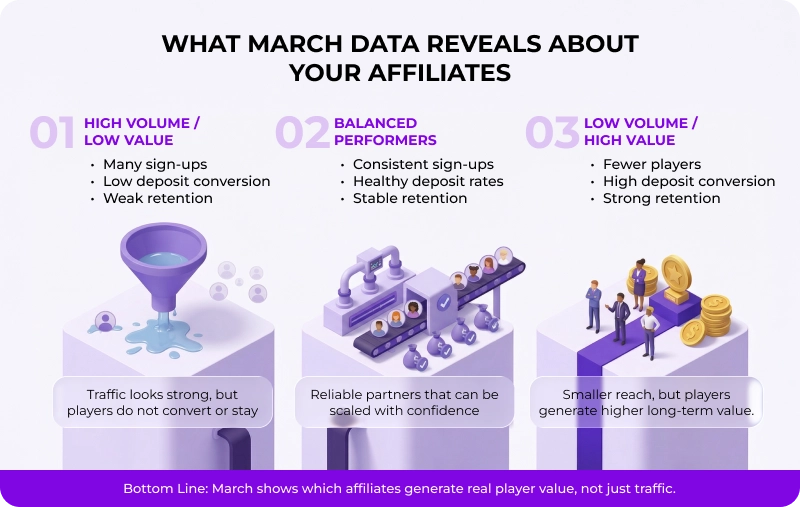
In practice, when affiliate data is reviewed in March, operators usually discover three distinct groups:
- High-volume affiliates with weak deposit behavior.
- Moderate-volume affiliates with strong retention.
- Low-volume sources with unexpectedly high player value.
Treating all three groups the same leads to inefficient budget allocation.
Why One CPA Target Distorts Reality
A common approach in affiliate management is to apply a single CPA target to all partners. This simplifies reporting but creates inaccurate conclusions.
Different affiliate types behave differently:
- SEO affiliates often convert slower but bring more stable players.
- Paid media affiliates generate fast deposits but can show higher churn.
- Influencers and streamers create delayed conversion patterns, often within 24–72 hours or longer.
If all of them are judged against the same CPA target, operators misinterpret performance. Modern online casino marketing software makes these differences visible, but visibility alone does not solve the issue. The key problem is how performance is evaluated. This becomes even more problematic when performance is evaluated too early.
Example from practice:
An operator reduced spend on influencer campaigns because same-day CPA appeared too high. When reviewed in March, those players showed higher repeat deposits compared to paid traffic that initially looked more efficient. The early decision to cut spend reduced overall player value. The issue was not the data. It was the timing of the evaluation.
The Metric That Shows Real Affiliate Quality
If there is one metric that consistently reveals affiliate quality in March, it is the deposit-to-registration ratio. This metric answers a simple question: How many registered players actually deposit?
This ratio varies significantly between operators:
- Strong affiliates: 1 in 2 or 1 in 3 users deposit.
- Weak affiliates: 1 in 8, 1 in 10, or worse….
Both may generate similar registration numbers, but their business impact is completely different. This is where combining affiliate data with CRM for iGaming becomes critical. Registration data alone shows intent. CRM data shows behavior.
When these datasets are connected, patterns become clear:
- Affiliates with low deposit ratios often produce short player lifecycles.
- Affiliates with strong conversion rates tend to drive higher retention.
- Some partners generate fewer players but significantly higher revenue per user.
This is how operators distinguish between traffic sources and revenue sources.
What March Data Reveals (Real Patterns)
Looking at aggregated operator data, the following scenario appears repeatedly:
- Affiliate A (SEO-driven)
- Moderate registrations
- Strong deposit conversion
- Stable retention over 60 days
- Affiliate B (paid acquisition)
- High registrations
- Acceptable deposit rate
- Declining activity after initial bonuses
- Affiliate C (influencer/streaming)
- Low initial registrations.
- Delayed deposits.
- Higher engagement and repeat sessions over time.
In January reporting, Affiliate B often appears strongest. In March analysis, Affiliate A and C generate higher overall value. Without reviewing March data, budget decisions are usually based on incomplete information.
Why Waiting Until Q2 Is a Costly Mistake
Most operators finalize Q2 budgets and affiliate agreements at the end of March or early April. If performance is reviewed after this point, the opportunity to act is already limited.
Waiting creates several issues:
- Underperforming affiliates remain active.
- Budget allocation reflects outdated assumptions.
- High-performing partners are not scaled in time.
If this review wasn’t done in March, April becomes the last opportunity to correct course before Q2 is fully underway.
March is the first window to act — and often the most effective one:
- Contracts can still be renegotiated.
- Budget can still be reallocated.
- Performance expectations can still be corrected.
This is the last point where insight can still change outcomes.
5-Step Operator Plan: NuxLite Execution
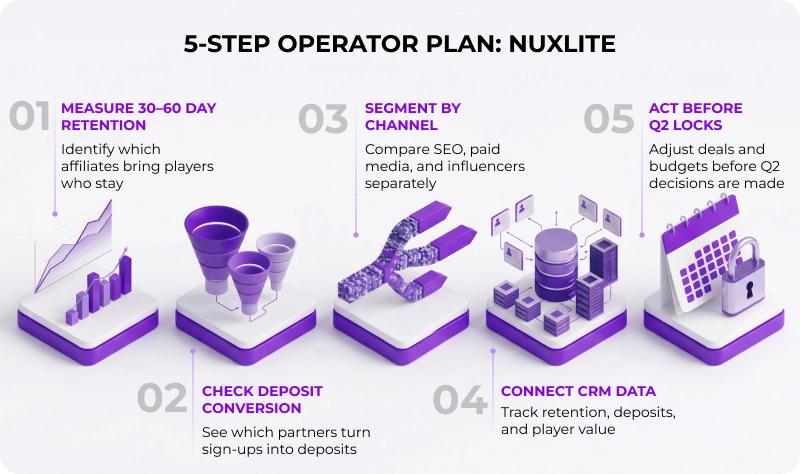
Operators should follow a structured approach if they want to transform March insights into practical decisions. Here’s what NuxGame recommends.
- Measure 30–60 Day Retention by Affiliate. Look beyond first deposits and track how players behave over time by affiliate source. This shows which partners bring players who stay and generate value. Affiliates with strong retention are the ones worth scaling.
- Check Deposit Conversion. Compare how many registered players make a deposit for each affiliate. This quickly reveals which partners send real players and which inflate registration numbers. Low conversion usually means low intent traffic.
- Segment Affiliates by Type. Separate SEO, paid media, and influencer traffic before evaluating performance. Each channel converts and retains differently, so applying one standard leads to wrong conclusions. Performance only makes sense when compared within the same channel.
- Combine Affiliate Data With CRM Metrics. Link affiliate data with retention, repeat deposits, and player value from your CRM. This shows which partners generate long-term revenue, not just initial conversions. Without this step, you’re optimizing for volume instead of value.
- Take Action Before Q2 Planning Locks. Use March insights to adjust deals and budgets before Q2 decisions are finalized. This is the last point where changes can still impact performance. Delaying action means carrying inefficient partnerships into the next quarter.
Early affiliate results in iGaming are like fast food, quick and attractive, but not always valuable. Insights we’ve gathered together with Basher Agency show that March is where you see the real nutrition. Some traffic fills the plate, some sustains the business. If you only count volume, you’re measuring calories, not real player value.

Denis Kosinsky
Chief Operating Officer at NuxGame
What This Changes for Operators
March shifts the focus from acquisition to evaluation. Instead of asking: “How many players did we get?” Operators should ask: “Which affiliates are generating players that actually deposit and return?” This distinction defines effective affiliate strategy. Operators who rely on early indicators continue optimizing for volume. Operators who act on March data optimize for value.
Wrapping It All Up
Timing defines how performance is understood in iGaming. January brings energy, February suggests direction, but March reveals what is truly sustainable. This is the point where short-term signals stop hiding long-term behavior. Operators who reassess performance in March move forward knowledgeably and confidently. Those who delay carry forward decisions that were never fully tested. It’s like judging a football game after the first few minutes: the real outcome is decided much later.