Русский
 Gibraltar Gaming License 2026: Costs & Rules | NuxGame

This authorisation now sits under the 2025 Act, which took effect on 1 April 2026. The Licensing Authority grants permissions, while the regulator supervises licence holders. A B2C application for one gaming vertical costs £30,000, with annual fees starting at £50,000. General duty is 0.15% of relevant gross profit above the first £100,000. The framework does not publish one universal licence term; its defining test is substantive local presence rather than a paper registration.
A Gibraltar iGaming license can suit businesses that need defined B2C and B2B categories within a mature commercial ecosystem. Gibraltar’s trade-off is substance: management, local employment, systems, tax contribution, and the location of remote infrastructure can all matter. Businesses comparing structures can use the NuxGame gaming license overview to place those requirements beside other jurisdictions before fixing the operating model.
The Licensing Authority, which is the designated Minister, grants permissions. The Commissioner supervises licensed activity, supported by the Gambling Division. The current Gibraltar gambling act is the 2025 Act, effective from 1 April 2026. The Gambling Act 2005 was repealed when the new framework commenced. The framework covers B2C, B2B, and support-service activity, including remote betting. It distinguishes remote gambling from physical activity and prevents one licence from authorising both formats. A B2C operator application for either games or betting costs £30,000. A B2B aggregator or platform-supplier application costs £20,000. Annual B2C fees begin at £50,000 per vertical when annual gross yield is below £20 million. The next bands are £100,000 and £200,000. The two general duties are 0.15% of relevant gross profit. The first £100,000 is exempt for those duties, but not for agency duty. The standard corporation tax rate is 15%. Gibraltar does not operate a VAT system, although other charges can apply in specific circumstances. The 2026 primary framework does not state one universal fixed licence period. Duration and renewal can be set through regulations and individual conditions. A single permission can cover more than one regulated activity. However, remote and land-based activity cannot sit under the same permission. Substantive presence is a statutory licensing consideration. Local equipment, jobs, management functions, and tax contribution can all affect the assessment. The licensing year runs from 1 April to 31 March. Annual fees are due on 1 April and normally payable by 30 April, while duty returns follow a quarterly cycle.
Gibraltar License Quick Facts
What Is the Gibraltar Gambling License?
The authorisation covers commercial gambling activities defined by the current 2025 statute. The official structure separates the Licensing Authority from the supervisory regulator. Searches for “Gibraltar Gambling Commission” or “GGC” are common, but neither is the formal name of a single licensing body. The official 2026 structure refers instead to the Licensing Authority, the Gibraltar Gambling Commissioner, and the Gambling Division.
The types of licenses now reflect the activity and customer relationship, not simply the product label. One business can seek approval for several related activities, but remote and non-remote services remain structurally separate. That makes the types of gambling licenses more useful for mapping a business model across casino, poker, bingo, sports betting, bet exchange, betting activity, and supplier services than older product-only descriptions.
- B2C Gambling Operator licence — permits approved consumer-facing services within the regulated scope.
- B2B Gambling Operator licence — covers approved services supplied to other licensed businesses, including aggregation and platform functions.
- Gambling Operator Support Services licence — covers specified support activity, including certain marketing, customer-fund, and ownership functions.
- Exchange or agent activity — covers approved models, including betting exchanges and agency arrangements.
- Physical-venue permissions — apply where regulated services are conducted from premises rather than through remote channels.
The strongest Gibraltar applications start with the operating map, not the form. Teams need to know which entity owns each customer relationship, where critical systems run, and which functions sit locally. When those decisions are fixed early, licensing evidence becomes easier to prepare, and technical changes during review become less disruptive. Denis Kosinsky Chief Product Officer at NuxGame
Both general duties are 0.15% of relevant gross profit, with the first £100,000 exempt. A bookmaker still needs to model the calculation base carefully because bonuses and marketing costs are not generally deductible from gross profit. The official register listed 58 licence holders when checked in August 2026, spanning B2C brands, bookmakers, B2B suppliers, and service businesses. The territory remains a specialist hub for gaming companies in Gibraltar, while gibraltar licensed gaming operators remain individually responsible for their own permissions and controls. Approved supplier activity can include content aggregation, platform services, hosted proprietary content, managed trading, identity checking, and contracted fraud functions. Teams assessing a supplier structure can compare the model with the NuxGame B2B gaming license guide before deciding which entity should hold the permission. A single licence can authorise more than one regulated activity when the scope is approved. This can help a business combine related services without treating every product as a separate legal vehicle, although remote and physical activity must remain separated. The base fee for a control change is £3,000, and the Licensing Authority can increase it according to complexity up to £30,000. That gives a buyer or investor a clearer starting point when planning an acquisition involving a licensed business. A reputable local framework may help banking, supplier, and counterparty discussions, yet access to global markets still depends on each destination’s rules and regulations. A brand operating globally must check destination permissions before accepting a bet or allowing customers to gamble.
Why Operators Choose the Gibraltar License
Low tax starts with a measurable duty rate.
The public ecosystem is substantial.
B2B scope is more explicit under the new framework.
The framework supports multiple commercial models.
Change-control costs are defined.
Market reputation can support expansion, but it is not a passport.
Gibraltar Licence Costs in 2026
The 2026 fee model separates application charges, annual licence fees, duty, and change-control costs. Fees vary by activity rather than using one flat price. The current Duties and Licence Fees Regulations set the statutory amounts, while the annual B2C fee increases with gross-yield bands. Application charges are paid when the application is formally submitted and are generally non-refundable.
Activity
Application fee
Annual licence fee
B2C gaming operator
£30,000
£50,000 below £20m GGY; £100,000 at £20m–£300m; £200,000 above £300m
B2C betting operator
£30,000
£50,000 below £20m GBY; £100,000 at £20m–£300m; £200,000 above £300m
B2C lottery operator
£20,000
£100,000
B2C betting intermediary
£15,000
£100,000
B2C betting agent
£15,000
£50,000
B2B aggregator
£20,000
£85,000 for one vertical, plus £15,000 for each additional vertical
B2B platform supplier
£20,000
£85,000 for one vertical, plus £15,000 for each additional vertical
B2B direct integration
£10,000
Tier 1 £85,000; Tier 2 £50,000; Tier 3 £20,000
Contracted fraud, CDD, or ID service
£8,000
£50,000 for the relevant approved service
A new B2C business in the lowest yield band therefore has a £80,000 full-year fixed government-fee baseline for one vertical before duty. A new B2B aggregator starts from £105,000 on the same full-year basis. The budgeting premise should go further: local staff, office space, legal work, testing, banking, corporate administration, and technical deployment are outside those statutory fees. The licensing cost guide can help separate regulator charges from operational setup costs.
How to Get a Gibraltar Gaming Licence
The licensing process begins by defining the regulated activity, customer relationship, remote status, and local substance model. The threshold test is stringent, and a remote applicant must show sufficient substantive presence. Teams seeking to obtain a Gibraltar gaming license should therefore resolve ownership, platform scope, and local functions before filing the formal application and non-refundable fee.
- Map the proposed gambling business to B2C, B2B, support-service, exchange, remote, or physical activity.
- Decide which company will apply and document controllers, beneficial owners, directors, and each material shareholder.
- Prepare a business plan covering products, commercial flows, service providers, financial projections, and target markets.
- Assemble the necessary documents for fit-and-proper review, ownership verification, management, systems, and the required service address.
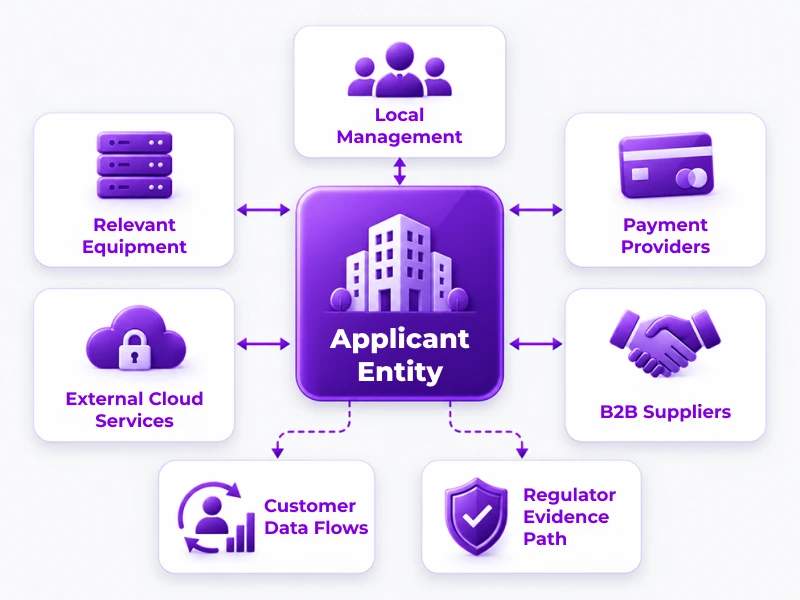
- Document remote systems, critical suppliers, hosting, data flows, security controls, and any outsourced functions.
- Prepare AML/CFT, compliance, customer-protection, responsible gambling, and financial reporting controls.
- Pay the prescribed application fee and submit the application through the route specified by the Gambling Division.
- Respond to requests for further evidence and keep the proposed operating model aligned with the filed scope.
Obtaining a Gibraltar licence should not be scheduled around an advertised fixed approval window. Current primary materials do not publish a universal end-to-end SLA for new applications. Review can expand when ownership is complex, the technical scope changes, outsourced providers are unclear, or the proposed local presence does not match the operating model. A disciplined evidence pack reduces avoidable rework without creating a guaranteed timetable.
Remote Infrastructure and the Substance Test
Remote activity can fall within the local framework when at least one piece of gambling equipment used for remote activity is situated in the territory, or when key management and organisational functions are carried on there. The Authority then considers substantive presence when deciding whether to grant a remote permission. The statutory factors include local equipment, employment, tax contribution, and the way the business is managed.
That does not create a simple rule that every production server must sit locally. It creates an architecture question: which systems, decision-making functions, and people demonstrate real substance? A Gibraltar online casino should map player-facing services, account systems, wallets, content, risk tools, and reporting flows before filing. Remote gaming design must also allow the regulator to understand how activity is controlled and where evidence can be produced.
The same mapping matters when third parties provide gambling services. Platform supply, aggregation, hosted content, managed trading, fraud tooling, customer due diligence, and identity checks can each fall within defined B2B categories. A clear responsibility matrix prevents a critical supplier from being treated as an invisible technical dependency during review.
2026 Rule Transition: Existing Codes, New Act, and Change Control
The new statute became operational on 1 April 2026, but the old technical rulebook did not disappear overnight. The Gambling Division states that existing codes issued under the previous framework remain in force until replacement codes are issued. Its current Codes and Guidance page still points licence holders to the Generic Code and Remote Technical and Operating Standards while future requirements are consulted.
That transition matters because regulatory changes affect both legal scope and implementation evidence. A system can be compliant with a current code yet still require changes when a new code is consulted and adopted. Change governance should therefore record which control comes from the new statute, which comes from an existing code, and which is an internal standard. This is also where a formal gambling transaction record, configuration history, and release approval trail become valuable.
Administrative timing is equally concrete. The licensing year runs from 1 April to 31 March, annual fees are normally payable by 30 April, and quarterly returns are due on 15 July, 15 October, 15 January, and 15 April. Payment follows by month-end. Even when no customer chooses to gamble during a quarter, a nil return should still be filed.
Technical Snapshot: Evidence Expected Before Launch
The regulator’s threshold tests reach beyond the front-end product. Evidence should show who controls the business, where critical functions sit, how customers are protected, and how financial figures can be reconstructed. The table below turns those expectations into an implementation checklist rather than treating regulatory standards as policy documents kept outside the product stack.
System area
Implementation requirement
Evidence to retain
Corporate scope
Map each regulated activity to the correct entity and permission
Activity matrix, entity chart, approved scope
Ownership
Identify controllers and material ownership links
Group chart, controller records, fit-and-proper pack
Local substance
Show meaningful local functions and relevant infrastructure
Staff plan, service map, equipment inventory
Platform controls
Protect remote systems and manage material technical changes
Architecture, access records, release history
Customer onboarding
Apply age, identity, financial-crime, and risk checks
KYC logs, screening outcomes, case records
Player protection
Prevent minors and support customers who gamble responsibly
Limits, exclusion records, intervention logs
Finance and duty
Reconstruct stakes, payouts, gross profit, and duty
Ledger, reconciliations, quarterly return files
Privacy and security
Control personal data and security incidents
Processing register, risk assessments, incident log
ISO/IEC 27001:2022 is useful as an information-security control framework, but it should not be presented as a statutory licensing prerequisite unless a specific condition requires it. Its practical value is architectural: maintain an asset inventory, assign risk ownership, control privileged access, record incidents, and test recovery. The current ISO 27001 standard gives teams a common control language across cloud, platform, and operational functions.
How the Gibraltar License Compares With Other Licenses
Headline taxation rarely decides the better jurisdiction on its own. Substance, market recognition, local staffing, banking access, hosting rules, and product scope can outweigh a smaller application fee. The useful comparison is therefore the binding operational constraint, not a single number.
- Isle of Man (GSC) — £5,250 application and £36,750 annually in the NuxGame 2026 roster. Typical planning window: 10–12 weeks. Constraint: on-island infrastructure and local-substance requirements.
- Malta (MGA) — €5,000 application plus activity-based annual charges and contribution. Typical planning range: 6–12 months. Constraint: vertical-specific approval, capital requirements, and detailed supervisory controls.
- Curaçao (CGA) — €4,592 application and approximately €47,450 annually in the NuxGame roster. Typical planning range: 3–6 months. Constraint: local company, physical office, and local hiring.
- Kahnawake — approximately $40,000 in year one, then $20,000 annually in the NuxGame roster. Typical planning range: 8–12 weeks. Constraint: primary server requirements inside Mohawk Territory.
- Tobique (TGC) — from approximately $36,000 annually in the NuxGame roster. Typical planning range: 4–8 weeks. Constraint: narrower recognition outside North America.
- Anjouan — from approximately €17,000 annually in the NuxGame roster. Typical planning range: 4–8 weeks. Constraint: more limited acquirer appetite on some fiat rails.
- Costa Rica — commercial setup is based on a local company structure rather than a conventional gambling licence. Constraint: the model does not provide the same regulator-issued permission used in jurisdictions with dedicated licensing regimes.
The Gibraltar advantage is not automatic market entry. Its licence can support an international operating structure, but point-of-consumption law still governs where a brand may offer online gambling. That distinction matters especially in tightly regulated markets, where a local authorisation can remain necessary regardless of the licence held elsewhere.
How NuxGame Helps With the Gibraltar License
Applications usually slow when legal scope and technical scope describe different businesses. The NuxGame legal team can coordinate company registration, beneficial-ownership documentation, policy preparation, banking and PSP setup, and submission planning with external advisers where required. The platform-readiness review then checks whether the proposed entity map, customer flows, third parties, and reporting model match the filed gambling business.
The technical work is equally specific. The NuxGame turnkey casino platform can be mapped against the approved operating model, including platform services, integrations, access roles, financial ledgers, and supplier boundaries. This reduces late restructuring when a brand adds a new product, payment route, or B2B dependency. It also keeps reporting data and financial evidence tied to the same configuration presented during licensing.
Planning a regulated launch? The NuxGame team can help map the legal scope, platform architecture, and evidence package before filing, so the application reflects the operation you actually intend to run.