Русский
 The Real Product Is Trust: How iGaming Brands Earn It in 2026
Ask ten operators why they chose their platform provider and almost none of them will start with the technology. Nobody says the casino API docs were excellent. They say a name. The person who picked up the phone on a Sunday. The one who flagged a licensing problem before it turned into a fine. The one who introduced them to a payment provider that actually settled on time in their market.
Yanina Kaplya, Chief Marketing Officer at NuxGame, has spent the better part of a decade on the B2B side of this industry. She treats that pattern as the starting fact of the job, not a nice sentiment to put on a slide.
In B2B marketing, relationships play a huge role because companies often choose to work with people they trust rather than simply buying a product.

Yanina Kaplya
Chief Marketing Officer at NuxGame
In an interview with iGaming News Today, she laid out how that belief turns into a strategy: an ecosystem instead of a product catalog, community instead of campaigns, and a marketing team that now has to earn trust from two very different audiences at once. Here’s what that looks like, and why it matters more in the second half of 2026 than it did a year ago.
People Buy From People, Not Feature Lists
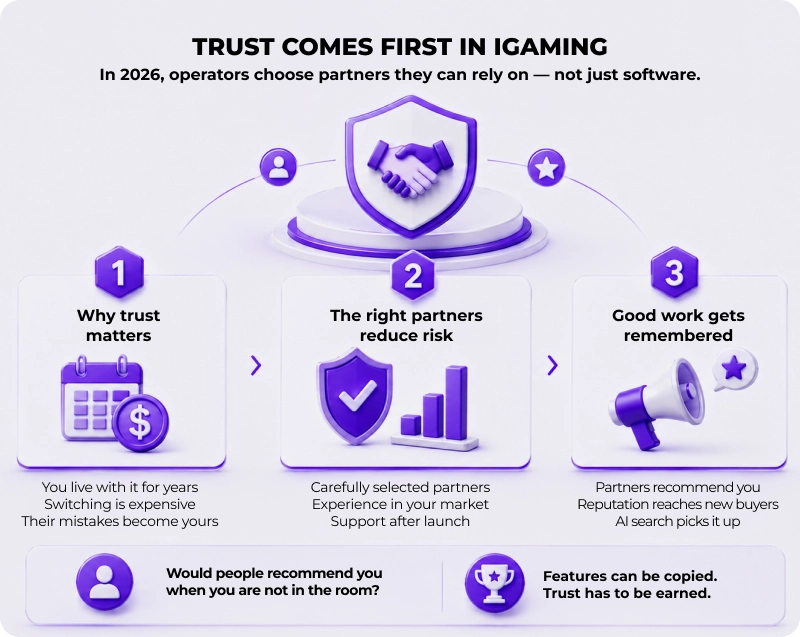
An operator signing with a platform provider isn’t buying a piece of software for a quarter. They’re accepting a dependency that will sit under their entire business for years. Migrating later means moving player data, rebuilding integrations, re-certifying in every market, and explaining the downtime to affiliates who will not wait. Worse, the provider’s compliance failures become the operator’s regulatory problem. When a regulator asks questions, “our vendor handled that” is not an answer that saves a license.
Regulators are now looking at both ends of the chain. On May 7, 2026, Ontario’s AGCO served Relax Gaming and Arrise Solutions (which powers Pragmatic Play) with monetary penalties of C$40,000 each, after finding their games on unregulated sites reachable by Ontario players. In July, Evolution Malta agreed to pay £4.75 million to the UK Gambling Commission, after an investigation found its games on six unlicensed sites accessible to consumers in Great Britain. The regulator pointed to an outdated anti-money-laundering risk assessment and weak oversight of the company’s own supply chain, and said the failings were serious enough to consider suspending the license. Both cases ran the same way: the penalty followed the partner choice. So the vetting has to happen before you sign, not after a regulator calls.
The buyer is really making a bet on how a company will behave in 18 months, under pressure, in a market neither side has entered yet. No feature list answers that question. No demo does either. Trust is the only available proxy, which is why relationships aren’t the soft layer on top of B2B iGaming sales — they are the mechanism.
Yanina came into the industry from IT and technology, and moved almost immediately to the B2B side, where she has focused on brand strategy, storytelling, and long-term positioning. Her role at NuxGame, as she describes it, is to strengthen the brand narrative, communicate the products clearly, and position the company as a trusted partner for operators looking to grow.
Community Came Before Strategy
NuxGame was founded in 2018, which makes it young in an industry where “established” often means a decade of legacy code. Over the past year, the team ran a deep positioning exercise: how the products are presented, how expertise gets communicated, what value reaches operators.
“One important discovery during this process was that we had already built a strong community around our brand,” Yanina said. “Many of our partners share the same vision and values.”
That’s the reverse of how most companies work. The usual sequence is: define the brand, launch the campaign, hope a community forms around it. Here the community existed first, quietly, and the strategy was written to catch up with it.
Most positioning exercises start in a workshop and end in a deck nobody outside the room ever reads. The shortcut is to listen instead. Partners already describe you a certain way when you’re not on the call, and that description is your positioning whether you signed off on it or not. The only real choice is whether to build on it or argue with it. NuxGame built on it, and the strategy shifted from selling an iGaming platform to building an ecosystem around it.
What an Ecosystem Really Means
“Ecosystem” has been worn smooth by overuse, so it’s worth being precise about what’s being claimed.
As a platform provider, NuxGame sits next to a lot of verticals: game providers, payment solutions, affiliates, CRM systems, legal services, compliance tools. The lazy version of this is a marketplace — collect as many logos as possible, publish the number, let the operator sort it out. Yanina’s team went the other way.
Instead of simply integrating as many services as possible, we focus on carefully selecting trusted partners. Each one goes through an internal evaluation covering technology quality and their commitment to long-term client success.
Yanina Kaplya
Chief Marketing Officer at NuxGame
The difference between those two models is where risk lands. Game content shows the scale involved: the leading aggregators advertise anywhere from 12,000 to more than 40,000 titles, drawn from 150 to 300-plus studios, behind a single integration. Nobody has personally checked all of that, and games are the simple case — they either work or they don’t. Payments, compliance tools, and legal partners fail in slower, messier ways, and the operator is the one who finds out. A curated ecosystem absorbs some of that risk, because every partner in it is an implicit recommendation.
Curation has a cost. It is slower, and the logo wall stays smaller. What it buys is a network where the vetting is already done. That’s a large part of what an operator is paying for with a turnkey casino solution: a short list you can trust instead of a long list you have to check yourself.
Launch Is Not the Finish Line
Here’s the part of the interview that names the problem, then answers it.
Once the software is delivered, operators are often left to manage the rest of the process themselves. We want to guide operators through the entire journey, from launching their platform to developing a clear growth strategy.
Yanina Kaplya
Chief Marketing Officer at NuxGame
Anyone who has watched a new brand launch knows exactly what Yanina is describing. Go-live is treated as the finish line by the vendor and the starting line by the operator. The platform works. The games load. And then month three arrives: acquisition costs come in higher than modeled, retention is thin because nobody built a CRM flow, one payment method quietly fails for 20% of deposits, and the first compliance review lands on a team that hasn’t staffed for it. None of that is a software defect. All of it kills brands.
The NuxGame answer is to stay in the room after delivery, connecting operators to the right partners and helping them build a roadmap designed to produce measurable results in the first months of operation, not the first year. “For us, success is not just about selling a product,” Yanina said. “It is about building long-term partnerships and helping our clients succeed in a competitive market.”
There’s a commercial logic here that has nothing to do with generosity. In a revenue-share world, a provider whose clients stall at month three has built a portfolio of dead accounts. Helping operators start an online casino business that grows is the same thing as protecting your own revenue line. The interests genuinely align, which is rare enough to be worth saying out loud.
Where the Buyers Are
Then there’s the challenge that makes iGaming marketing structurally strange. “The iGaming industry is relatively small, and not all decision-makers are active on traditional professional networks,” Yanina said.
Underneath that polite sentence is a real headache. The people who sign platform deals are frequently invisible to every standard B2B channel. They’re not building a LinkedIn presence. They’re in private Telegram groups, in closed WhatsApp chats, in side meetings at SBC and SiGMA that never appear on any agenda. You cannot target them, because the targeting data doesn’t exist. You often cannot advertise to them either, since gambling-adjacent ads run into platform restrictions and territory rules before they run into budget limits.
So the channel that works is the oldest one: being talked about accurately by someone the buyer already trusts. Reputation is the only thing that travels into rooms you’re not in. That’s why the NuxGame marketing budget behaves less like a demand-generation engine and more like a trust-building operation — events, partnerships, co-branded work, and the slow accumulation of people who will vouch for you unprompted.
Now the Machines Have to Trust You Too
The second challenge Yanina raised is newer, and it’s changing faster than anything else on the list.
Marketing teams now need to think beyond traditional SEO and ensure that their content is also optimized for AI-driven discovery and analysis.
Yanina Kaplya
Chief Marketing Officer at NuxGame
Consider how a shortlist gets built in mid-2026. Before anyone talks to a salesperson, someone opens an AI assistant and asks which platform providers are strongest for a specific market, which ones handle local payments properly, which ones have a reputation for supporting operators after launch. Whatever comes back is the shortlist. Vendors that don’t appear in that answer aren’t losing the deal: they’re never entering it. Winning AI search is how you get on the list.
What makes this less alien than it sounds is that the model is asking the same question the human buyer is: can this company be trusted to do what it says? It just reads different evidence. It weighs how you’re described on forums and video platforms, what independent sources say, which brands you’re consistently mentioned alongside, whether your content is structured clearly enough to be quoted at all.
Two audiences, one underlying question. The operator wants a partner. The machine wants a reliable source. Both are looking for proof of the same thing, and both are increasingly reached the same way: by being credible in places you don’t own.
AI for Work, Humans for Relationships
The internal response of NuxGame has been to push AI deep into the parts of marketing that scale (data analysis, campaign management, content production), while protecting the parts that don’t. “Our goal is to combine technology-driven marketing with meaningful industry connections,” Yanina said.
That split is the whole strategy in one sentence, and it’s sharper than it looks. AI has collapsed the cost of producing decent content to roughly zero, which means decent content is no longer evidence of anything. When every competitor can publish 40 polished articles a month, the floor rises and the differentiator moves somewhere a model can’t reach: the payment provider you personally called at midnight, the market entry you actually navigated, the operator who will tell anyone who asks that you didn’t disappear after go-live.
Automate the analysis. Automate the production. Then spend the hours you just saved on the things that only a human can be held accountable for. Teams that get this backwards (automating relationships and agonizing over content calendars) will produce more output every quarter and less trust.
What Comes Next in 2026
The priority Yanina named for the rest of the year is expansion: growing the ecosystem, deepening partnerships, and helping operators enter new markets successfully. That last piece is where the whole argument closes. Market entry has become the hard part in iGaming. Every newly regulated territory arrives with its own licensing rules, payment methods, advertising restrictions, and player habits, and none of it transfers cleanly from the last market you launched in. A provider that hands over online casino software for a market it doesn’t understand has delivered an expensive problem.
An ecosystem is one of the few structures that answers this honestly, because no single vendor can be an expert everywhere. What it can do is know exactly who is — and be trusted enough that the introduction is worth something.
Which brings the argument back where it started. In an industry where you can’t buy attention on the big ad platforms, can’t reach the buyers through normal channels, and can no longer count on ranking your way into a search result, one asset still compounds: being the company that people, and now machines, recommend when you’re not in the room.
This article was adapted from Yanina Kaplya’s interview with iGaming News Today. Primary source: https://igamingnewstoday.com/company-news/nuxgame-cmo-yanina-kaplya-igaming-marketing-ecosystem-ai/