Русский
 Marketing to the Machine: How iGaming Brands Win AI Search in 2026
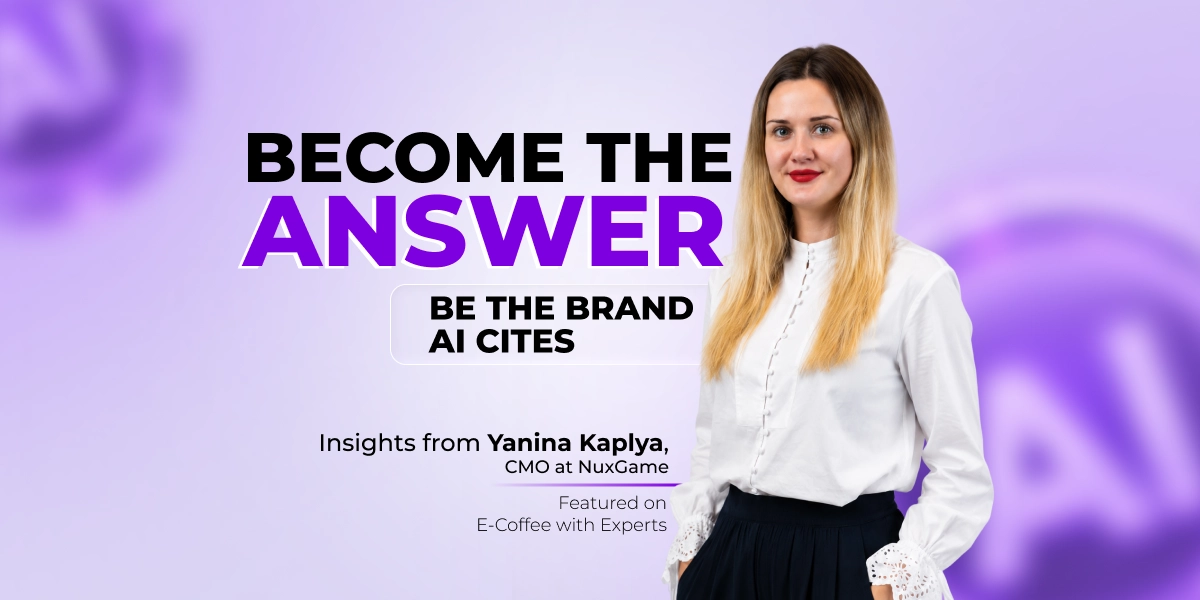
Most marketing teams treat artificial intelligence like a very capable intern. It writes the copy, builds the dashboard, drafts the report, cleans up the deck. Useful, tireless, slightly disposable. Our CMO, Yanina Kaplya, thinks that framing is exactly why so many brands are losing ground in search right now.
“We rarely think, okay, which value does my brand bring to AI in order for it to perform its job,” she said in a recent conversation on E-Coffee with Experts. Flip that question around and the whole picture changes. The brands climbing into Google’s AI summaries aren’t the ones extracting the most from AI. They’re the ones the machine actually wants to cite.
That reversal sits at the center of how her team works, and it has consequences for anyone trying to run an online casino business in 2026. Here’s what she’s seeing, and what she’d tell any operator or agency still optimizing for a version of search that quietly stopped existing.
Why the Best SEO Framework Is Having No Fixed Framework
Ask Yanina for the system her team runs on and she’ll happily admit there isn’t a single one.
“I would be really happy to say that there is a framework that works every day for a year,” she said. “But the way we approach things is that we really just monitor data every day.”
The team keeps a running list of KPIs across their lead-generation channels and reads them constantly. Link building, content pipeline, PR, co-branded work — all of it gets watched, and all of it is provisional. If a tactic drifts off course for three days and isn’t recovering, they pull it. Fail fast, learn fast. Then they try again from a different angle.
SEO makes this harder than it sounds, because the feedback loop is slow. You won’t know if something worked tomorrow. You give it ten to fourteen days, sometimes a little less, and only then do you read the signal. Yanina compares it to testing for an allergy: strip everything back, then reintroduce one variable at a time and watch what the data does.
The reason for all this churn is simple. Fifty new AI tools seem to appear every day, and some of them are genuinely useful while most are nothing to write home about. You can’t tell which is which without testing. So the team builds with Plan B and Plan C already drafted, because tomorrow usually brings another change. For anyone who wants to start an online gambling business and assumes marketing is a set-and-forget line item, that’s the first illusion to drop.
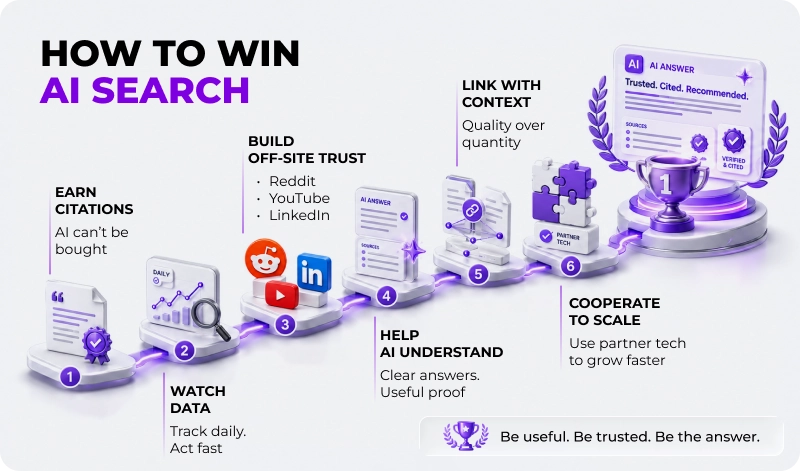
Stop Asking What AI Can Do for You. Ask What You Do for AI
For years, the search hierarchy was easy to read. Paid ads at the top, then whoever did SEO well underneath. Now the first thing most people see is an AI-generated summary, and you can’t buy your way into it.
“You cannot go and pay Google to be in Google summary,” Yanina pointed out. “They have their own algorithm which is AI based. And basically, this is your fantastic chance to be ahead of those who really paid money to be on position one and position two.”
This matters more in iGaming than in almost any other industry, and it’s worth being blunt about why. Most brands treat paid search and paid social as a safety net: if you can’t rank, you buy reach. Operators don’t get that net. Google and Meta gate gambling ads behind certification, restrict them by territory, and ban them outright in plenty of markets. So when the paid lane is already narrow and the AI summary can’t be bought at any price, organic and answer-engine visibility stop being one option among many. For a casino brand, they’re often the only door left into the results at all. Learning to earn a citation instead of renting a slot isn’t a growth tactic here: it’s how you stay visible.
Earning that citation has nothing to do with the old playbook of checking Google’s update notes and adjusting accordingly. It means understanding how the model itself decides whether your content is trustworthy enough to surface.
You need to really understand the robot. You need to be really smart in the way you approach understanding and learning from machines that learn from you.

Yanina Kaplya
Chief Marketing Officer at NuxGame
This is the part she keeps circling back to, because it’s where most brands have the relationship backwards. AI is supposed to serve us: write, design, summarize, report. Far fewer teams ask what they’re putting into the system that makes the model’s job easier. Do your marketing job well enough, Yanina argues, and the AI starts to enjoy working with your brand. It surfaces you in the summary. You end up ahead of the operators who paid for the top three positions, and you spent less doing it.
None of this means abandoning the fundamentals. Keywords, technical optimization, watching Google’s algorithm: that all still runs in parallel. The shift is adding a second discipline on top: being curious and creative enough to test whether your brand actually gives value to AI.
Where AI Search Actually Looks Now: Reddit, YouTube, and Quora
The other big change is what Google trusts. It used to be that nobody expected a search engine to lean on a Reddit thread or a Quora answer. Now those are exactly the places it goes.
“Currently Google would go to platforms like YouTube, LinkedIn, Reddit, and Quora, and all of the other places where people interact with each other,” Yanina said. “And then Google would trust this information and they would actually take it and add it into AI search results.”
For operators, that reframes where credibility gets built. The conversation about your brand on a forum or a video channel isn’t ambient noise anymore. It’s training material for the systems that decide who gets recommended. Teams that create a gambling website and treat owned content as the only thing that matters are working with one hand tied behind their back.
How to Reverse-Engineer ChatGPT and See How It Picks Brands
Here’s the problem that haunted Yanina for most of her career: how do you measure brand marketing? SEO gives you a dashboard. Brand work gives you a feeling. How do you prove the PR landed, the media buy reached the right people, the partner interview hit the right topic with the right audience?
AI, oddly enough, turned out to be the answer.
The method is reverse search. You ask the model directly how it would decide to recommend a brand like yours. “If you are stubborn enough,” Yanina said, “you can really have a good conversation with ChatGPT.” Keep pushing and it will tell you which sites it weighs, what it considers trustworthy, what every strong content piece on your site needs to include. Sometimes that checklist is concrete: infographics, images, quotes, tables. You can write brilliant content, but if it doesn’t match how the model wants information packaged, it won’t carry you. The same scrutiny that goes into your online casino design belongs in your content format, because both are being read by a machine with opinions.
The conversation goes further than format. You can ask which partner brands raise your own trust rating, and slowly map your actual sphere of influence. Everyone is an influencer inside some circle, Yanina points out, and B2B is no different from B2C in that respect: you have a niche where your word carries weight. Knowing your strongest reach, your real audience, and the brands you should be seen alongside used to be unmeasurable. Now the AI hands you that feedback for free.
This is the logic underneath NuxGame SEO strategies: don’t guess what the machine values, interrogate it, then test the answer the same way you’d test anything else. As Yanina put it, rose-colored glasses and illusions aside — you check whether the results match the expectation before you scale.
What Is Co-Opetition and Why Partnering With Rivals Wins
A recurring theme in the interview was what happens when you stop trying to own the whole product.
Yanina described the old industrial model: one plant built an entire car from scratch, start to finish, in-house. Then systems opened up. Parts came from elsewhere, design from somewhere else, and a factory could simply license its blueprints and get paid for the intellectual property without producing a single unit. That shift, she argues, has fully arrived in digital.
“You no longer need to spend years creating a feature that you can just integrate from a partner that might be your competitor,” she said. Your basic version of a feature might be fine on its own. As a premium offering, you partner with a rival to deliver something better, and the client wins. The time you save and the value you add tend to outrun whatever you’d have gained by guarding your moat for a year.
Yanina is unambiguous about it: she’s a total ambassador for co-opetition, and sees no harm in becoming an ecosystem where partners plug their solutions into your product and multiply the value reaching the end client. This is why a modular online casino builder beats a closed one: an operator can assemble exactly the stack they need rather than waiting on a single vendor to build everything.
It connects to a point from The Digital Seeker, the book by Bloomreach’s founder, which the interview kept returning to: the three A’s reshaping digital are AI, Ambience, and APIs. The API piece is precisely this. You don’t have to provide everything. You let other people contribute to your client’s success through their integrations, and everyone moves faster.
Why There’s No All-In-One AI Marketing Tool (Yet)
Plenty of vendors will sell you a single platform that bundles every AI tool you could want into one tidy dashboard. Yanina’s team demoed exactly that recently. It was clever. It also didn’t work for them.
What did work was using the same set of AI tools separately. They optimize content production, run copy through systems that flag whether a machine reads it as AI-written, check keyword density, and lean heavily on Claude, ChatGPT, Gemini, and a rotating cast of video and graphics tools. But there’s no single rig you load everything into and forget.
Unfortunately, at this point there is no magical pill. You still need a human on top as a manager of all of the robots and AI tools in order to give the proper task for these systems to work.
Yanina Kaplya
Chief Marketing Officer at NuxGame
The reason no permanent stack exists is the same reason the framework keeps changing. The tool that delivers this month might get cancelled next month for something better. So the team tests a new AI roughly every few weeks. If it earns its subscription, they keep it. If not, they move on.
How Link Building Changed: Context Now Beats Volume
Ten years ago, link building was a volume game. Whoever bought the most links won, and almost nobody stopped to ask whether a domain was worth being associated with.
“Ten years ago, forget about it,” Yanina said. “It’s different than it was six months ago.”
The turning point was realizing a bad domain could actively devalue a brand. That ended the mindless scaling. What replaced it is context. AI doesn’t really care about the old tags (nofollow, dofollow, sponsored, UGC) the way the industry once obsessed over them. What it weighs is the surrounding sentiment and the relevance of the mention. A link now has to sit in the right place, carry the right keyword, and genuinely strengthen the content it lives in.
Yanina’s summary is clean: previously, the more links the better; now, the smarter you link, the better. Quality over quantity, finally meant literally.
Why Speed (Not Budget) Is the Real Edge in iGaming Marketing
Asked what NuxGame does that competitors haven’t caught up to, Yanina’s answer wasn’t a tactic. It was a willingness to accept reality.
When she entered iGaming in 2019, agencies could make a brand with banner ads, video, podcasts, and content. You bought the package, and a year later the job was done. A lot of those agencies still operate as if that’s true. They treat AI, the changes in link building, and the new SEO logic as a fun game rather than the actual ground shifting under them.
The numbers she quoted are blunt. When her team asks former agency partners to come back with a plan built around answer-engine optimization, roughly 60 to 70 percent return with the same traditional marketing menu. “Everyone talks about AI,” she said, “but they really don’t want to implement it.” Implementation is the gap.
The interviewer framed the conclusion and Yanina didn’t hesitate to agree with it: speed is the differentiator now. How fast can you spin something up, ship it, test it, and read the feedback? Companies that are bloated and still anchored to traditional SEO metrics are betting those metrics will matter in six months. Nobody can promise they will.
For any team running or building in this space, the takeaway is uncomfortable but freeing. The advantage no longer belongs to whoever has the biggest budget or the longest-running strategy. It belongs to whoever is curious enough to keep asking what the machine wants, and quick enough to act before the answer changes again.
This article was adapted from Yanina Kaplya’s interview on E-Coffee with Experts. Primary source: https://www.digitalwebsolutions.com/interview/yanina-kaplya/