Русский
 Trends in Online Casino Software Development 2026

Online casinos have always been pioneering the next era of online entertainment, but 2026 is bringing a new kind of transformation. Forget the hype about technology for technology’s sake: this year is about making online casino software smarter, not merely more advanced. Faster, more secure, and highly adaptive gaming environments are now the standard, not a privilege. Players demand instant payouts, interactive gameplay, and consistent play across desktop and mobile.
At the same time, operators have to balance tougher rules while exploring fresh business opportunities. The biggest software developments this year will boost speed, security, and player satisfaction. AI is cracking down on fraud, blockchain is boosting trust: online gambling software is definitely getting smarter. NuxGame, a top casino API provider, gives operators the tools to stay competitive: fast integration, secure payments, and next-level gaming features.
TL;DR
What’s Trendy in Online Casino Development in 2026?
The main casino trends are not isolated technologies. They are connected parts of a stronger operating model: AI for risk and personalization, blockchain technology for transaction visibility, cloud infrastructure for performance, and compliance automation for safer growth. This is where casino technology becomes a business tool, not just a technical upgrade.
Companies should also look at market trends through a practical lens. A feature is only useful if it improves conversion, reduces manual work, protects players, or supports expansion into new markets.
| Trend | Business value |
|---|---|
| AI and big data analytics | Better decisions, risk scoring, and personalization |
| Cloud infrastructure | Better scalability and uptime |
| Localized payments | Higher deposit success and faster withdrawals |
| Gamification | Higher user engagement and retention |
| Compliance automation | Lower operational risk |
| Live casino formats | Stronger interaction and longer session times |
The forecast for the online casino market remains positive as more players move from land-based casinos to digital products. EGBA and H2 Gambling Capital said Europe’s gambling gross gaming revenue (GGR) reached €123.4 billion in 2024, up 5% year-on-year, with online gambling moving closer to a 40% share of the market.
For operators, the real test of casino technology is not how many features it shows in a demo. It is how calmly the platform behaves on a busy day: when payments are moving, reports are needed, risk signals appear and players expect everything to work without delay. A good system should give the team control before problems become visible to the player

Denis Kosinsky
Chief Product Officer at NuxGame
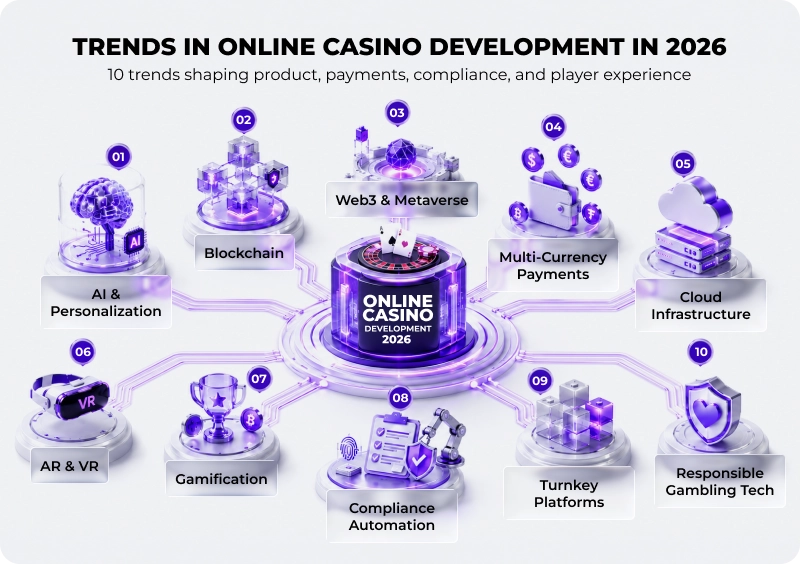
1. Artificial Intelligence for Personalized Gaming and Better Security
Artificial Intelligence is becoming a practical layer in the operation of the business. For platform owners, its value comes from the speed at which it converts player behavior into actionable insights. Instead of reviewing every action manually, teams can identify suspicious activity sooner. They can also handle service requests with more context and deliver a more relevant experience to players.
AI works best as a decision-support tool rather than a replacement for human oversight. It highlights unusual login behavior and draws attention to changes in payment activity. It can also reveal early signs of system abuse. Beyond risk management, the same information helps adapt the gaming experience to individual preferences.
Main AI use cases:
- Fraud and abuse detection;
- Player segmentation and big data analytics;
- Support automation and smarter ticket routing;
- Responsible gaming alerts;
- Personalized content and offer recommendations.
At NuxGame, AI is used less as a “full automation” layer and more as a faster way to read platform and player signals. It can show how users react to certain game mechanics, which themes they return to, where payment hesitation appears, or when session patterns start to point toward churn. This gives platform owners earlier context for decisions that used to depend on delayed reports.
It also applies to security and responsible gaming. When AI is connected to payment checks, login monitoring, bonus rules, and player limits, it can flag unusual activity sooner and pause recommendations when risk signals appear. The value is not automation for its own sake, but earlier detection, faster action, and fewer blind spots across the player journey.
AI-Agent Orchestration: Automating Live Game Management and Support
AI-agent orchestration helps operators manage live activity with less manual delay. Instead of using AI only for separate tasks, the platform can connect signals from gameplay, support requests, payment checks, and risk monitoring into one controlled workflow.
For example, the system can detect unusual behavior during a live session and prepare the case for review. It can also give support teams more context before they respond to a player. The final decision should still stay with the operator’s team, especially when the case affects account access, payments, or responsible gaming. For platform owners, this creates a faster operating model. Teams can react earlier, keep records, and reduce blind spots during high-traffic periods.
2. Blockchain: More Trust, Less Complexity
Blockchain technology still has a place in the casino industry, but only when it solves a real platform need. It works well for transparent transaction records. It also supports crypto wallets, faster settlement and selected provably fair mechanics.
| Use case | Value |
|---|---|
| Crypto deposits and withdrawals | Faster fund movement where legally allowed |
| Smart contracts | Automated settlement logic |
| Provably fair mechanics | More visible game result verification |
| Wallet integrations | Better access for crypto-native audiences |
For traditional casino brands, blockchain works best as a payment and trust layer rather than a full business model. For crypto-first brands, it can sit closer to the core product, but AML monitoring, wallet checks, and reporting still need to lead the implementation.
Blockchain as a Backend: Implementing Provably Fair Math in Slots
Blockchain can support slot development as a verification layer, not only as a payment tool. In a provably fair setup, the system creates proof before the spin starts, so the final result can be checked later. This helps show that the outcome was not changed after the round began.
The full game does not need to run on-chain. A practical setup keeps gameplay fast on the platform side while blockchain stores the proof data. For operators, this can improve trust with crypto-first players without slowing the game or making the interface harder to use.
3. Web3 and Metaverse: Selective Innovation for Casino Platforms
Web3, virtual casino games and immersive experiences are still among the trends in the industry but platform owners must use them carefully. Faster value for most platform owners comes from payment speed, retention tools, compliance automation and live casino performance. But Web3 can unlock tokenized loyalty, VIP communities, wallet-based access and digital collectibles where there’s a commercial reason to do so.
Best-fit Web3 applications:
| Feature | Best use |
|---|---|
| Wallet login | Crypto-native audiences |
| Tokenized rewards | Loyalty and VIP campaigns |
| Digital collectibles | Promotional drops |
| Virtual spaces | Branded events and player communities |
The real trend is selective innovation. Use Web3 in online casinos where it improves ownership, loyalty, or user engagement, and avoid adding features that increase cost without improving the product.
4. Multi-Currency Payments and the Power of Crypto
Payment flexibility is one of the strongest trends in online gaming. Players expect deposits that work quickly and withdrawals that do not take days. Operators need the same cashier system to support AML checks, limits, reconciliation, fraud controls, and market-specific rules.
Crypto is part of this shift, but the wider trend is localized payment options. A strong cashier gives each market the payment experience it expects, including cryptocurrencies where regulation and player demand support them.
A modern cashier should manage:
- Payment methods by country and currency;
- Routing by risk level and availability;
- Automated payout checks;
- Wallet balance logic;
- Transaction history for support teams;
- Alerts for unusual deposit or withdrawal patterns.
A secure payment setup also takes pressure off support and finance teams. In NuxGame, operators can now upload custom logos for the Changelly payment method and track crypto transactions more accurately in deposit and withdrawal reports. This helps separate actual CoinPayments transactions from those processed through Changelly, making reporting clearer for teams that work with multiple crypto payment flows.
The same logic applies to payout control. With the new delayed bank rejection support, late bank declines can be handled through a reversal transaction flow, updating a payout from Completed to Rejected when the decline is received after initial approval. For platform owners, this means cleaner payment history, fewer manual checks, and more accurate balance updates after each bet, bonus use, or payout request.
5. Cloud Technology in Online Casinos
Cloud infrastructure is now a core part of software development for the casino industry. Casino business owners need platforms that stay stable during traffic peaks. A campaign, tournament, new event or launch of new games should not slow the product at the moment when players are most active.
The value of cloud is not only scalability. It also supports monitoring, faster releases, backups, disaster recovery, and better integration management for growing casino companies.
Technical Snapshot
| Layer | What it supports |
|---|---|
| Application | Wallet, CRM, KYC, affiliate, reporting, and content modules |
| Data | Encryption, access control, backups, retention rules, and recovery |
| Integration | APIs for games, payments, risk tools, analytics, and partner systems |
| Monitoring | Alerts for latency, failed payments, suspicious logins, and traffic spikes |
| Compliance | Audit logs, player limits, reporting, and RG tools |
The platform should align with recognized standards. GLI-19 standard is relevant for interactive systems, including player accounts, transactions and game records, reporting, random number generators, and system controls. ISO/IEC 27001:2022 is also important for information security management, risk treatment, and access control.
6. Engineering Immersion: The Tech Stack for AR/VR Casino Lobbies
AR and VR can add a stronger sense of presence to online casino platforms, but the visual layer should not work on its own. A virtual lobby has to recognize the player first. Then it should open the right journey, apply platform rules, and keep the operator’s team informed about what is happening inside the session.
The main development challenge is speed. When a player moves from a 3D lobby to a live table, the platform should react immediately. The same applies when a reward is used or when the session continues on another device. Each action has to be reflected in the platform without breaking the experience or creating extra manual work for the team.
| Component | Role in AR/VR casino lobbies | Technical requirement |
|---|---|---|
| Player access | Confirms who enters the immersive space | Secure authentication |
| Wallet logic | Keeps funds accurate during the session | Instant transaction updates |
| Game connection | Opens content from the lobby interface | Stable API integration |
| Loyalty layer | Shows rewards and VIP progress | Live data exchange |
| AR interface | Adds useful prompts to the screen | Lightweight rendering |
| Social controls | Manages avatars and user behavior | Scalable moderation |
AR can be a practical first step before a full VR environment. A live dealer screen can show table insights, progress prompts, or campaign messages without forcing the player into a heavy interface. The purpose is not to add immersion for decoration, but to make new formats support smoother payments, safer journeys, faster reporting, and long-term product growth.
7. Gamification as the New Standard in Player Retention
Gamification is a serious retention tool, not just a visual overlay. In a slot tournament, for example, progress needs to be clear from the first spin, so players understand what action comes next and why the reward matters. For operators, it creates a structured way to support repeat visits and adjust mechanics by player demographics without relying only on direct offers.
| Goal | Suitable mechanic |
|---|---|
| Repeat visits | Daily missions and reward calendars |
| Competition | Tournaments and leaderboards |
| Loyalty | Tier levels, cashback, and status rewards |
| Reactivation | Time-limited challenges |
| Product discovery | Missions across game categories |
Good game design matters here. Gamification should improve user engagement without creating pressure, and platform owners need clear control over eligibility, frequency, reward size, and risk triggers. At NuxGame, we also pay close attention to platform usability from the operator’s side: achievements, campaigns, player mechanics, and related settings should be easy to manage without unnecessary developer involvement. Our latest release reflects this approach, allowing teams to reset achievement progress directly from the Back Office while keeping the achievement itself active. For daily operations, this means teams can refresh mechanics, restart campaigns, and manage player progress with less manual work.
8. Stricter Rules, Smarter Solutions
Regulation is changing how platforms are built. Operators need KYC, AML, payment monitoring, reporting, and responsible gaming tools inside the product rather than managed through disconnected systems. Compliance is part of the platform, not a separate layer.
The UK Gambling Commission’s financial vulnerability rules show how detailed this area has become, with the threshold moving from £500 to £150 in net deposits over a rolling 30-day period. This is why automated monitoring and clear records matter.
Compliance areas to connect inside the platform:
- KYC and identity verification.
- AML screening and transaction monitoring.
- Player limits, self-exclusion, and cooldowns.
- Bonus eligibility, wagering rules, and promotion records.
- Audit-ready reports for internal and regulatory review.
Big data analytics can help identify unusual patterns, but online casino owners still need governance around how data is used. Sensitive decisions should have documentation and review. For businesses, smarter compliance is about building a safer process that works at scale.
9. Turnkey Platforms: Fast, Flexible, and Ready to Adapt
Turnkey platforms remain popular because they reduce launch time and development pressure. Operators no longer need only a ready-made website; they need a framework that supports payments, content, CRM, risk management, reporting and future integrations.
A strong turnkey setup gives access to core modules from day one. It also lets platform owners adapt by market, product mix, brand style and player segment. This matters when growing demand pushes businesses to enter new regions faster.
What to check before choosing a turnkey platform:
- Target market and license compatibility;
- Localized payment methods;
- Loyalty tools;
- Reporting for finance, support, and compliance teams;
- Flexible API access;
- Provide expertise in casino operations, not only technology.
NuxGame gives companies a platform foundation that supports this direction. The goal is not only to launch quickly, but to keep improving the product after launch. Our top casino platform helps teams manage business operations with less manual work.
10. Responsible Gambling Tech: Protecting Players and Long-Term Revenue
Player safety is fast becoming the next competitive battleground in iGaming. Real-time analytics now flag risky behaviour as it unfolds: the UK Gambling Commission logged more than 4.7 million active online-slot accounts in March 2025, with 3.6 million sessions lasting over an hour (Gambling Commission). With Europe’s online gambling GGR reaching €47.9 billion in 2024, up 11.7% year-on-year, regulators and investors alike are demanding proof that growth and player protection go hand-in-hand. In short, embedding responsible-gaming tech is no longer a compliance box-tick; it’s table stakes for any casino that wants to thrive beyond 2025.
| Feature | What it does |
|---|---|
| Deposit limits | Supports safer spending |
| Time limits | Helps manage session length |
| Reality checks | Keeps players informed during play |
| Self-exclusion | Gives players stronger control |
| Risk scoring | Finds early warning signs |
| Intervention logs | Supports audits and review |
Responsible gambling should not be separated from growth. Safer tools help operators build trust with players, regulators, partners, and payment providers. In a more regulated industry, that trust becomes a commercial advantage.
Stay on Trend With NuxGame
For many platform owners, the main challenge is connecting the new tools into a system that works without extra pressure on the team. When payments, player checks, content, and retention features operate separately, growth becomes harder to manage. Each of these areas affects revenue, risk, or player trust. None of them should be treated as a separate afterthought.
NuxGame supports platform owners with software, integrations, game aggregation, payment tools, bonus systems, and back-office features built for long-term operation. For iGaming business owners looking to enter or expand in the market, the right platform makes growth easier to manage and gives teams more room to optimize the product after launch.