How to Get an Online Casino License in Canada in 2026
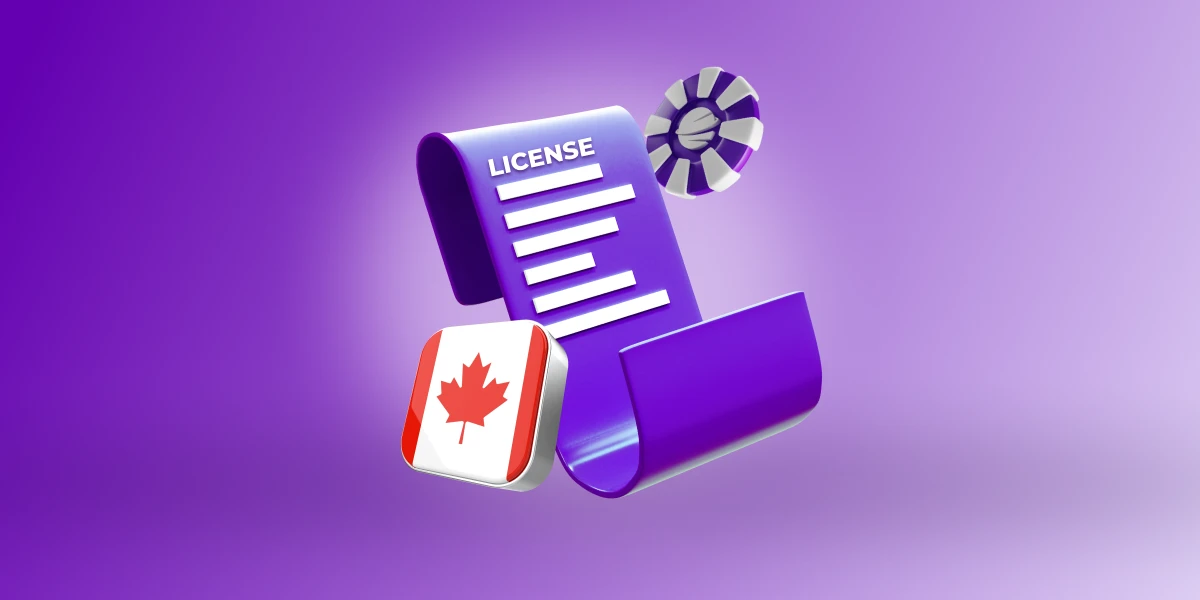
An operator primarily needs to choose the correct provincial or territorial licensing path if they want to obtain an iGaming license in Canada. That’s because the country does not issue one universal online casino license that covers every province. The market-entry process depends on where the operator plans to launch. For instance, a Kahnawake online gambling license is issued under the Kahnawake Gaming Commission framework. Ontario, by contrast, requires separate AGCO registration and an operating agreement with iGaming Ontario.
For a gaming operator planning a $50K platform decision, this choice affects legal access, payment routing, player onboarding, reporting, and launch timing. Ontario is currently the clearest commercial regulated path for private operators, because AGCO registration and the iGaming Ontario operating process are publicly defined. Other provinces may follow different rules, and each jurisdiction can regulate products, suppliers, player controls, and responsible gaming processes in its own way.
Can You Get One Online Casino License for All of Canada?
No. Canada does not offer one online casino license for every province because online gambling is dealt with through provincial and territorial systems. The federal Criminal Code lets provinces conduct and manage legal lottery schemes, and Bill C-218, the Safe and Regulated Sports Betting Act from the 43rd Parliament, allowed single-event sports betting through provincial systems, with horse racing treated separately.
The practical checks for serious operators are:
- Identify the province or territory.
- Check who conducts and manages the market.
- Confirm allowed gambling activities.
- Match platform controls to local rules.
- Prepare reporting before launch.
These checks decide which approval path, operating agreement, supplier model, player controls, and reporting format the operator must prepare before launch. Ontario is the clearest example because its regulated market has public performance data and a defined private-operator process. Ontario’s market reached $82.7B in wagers, 50 active operators, and $2.9B in gross gaming revenue in 2024–25.
An Ontario-ready setup must match AGCO registration, iGaming Ontario onboarding, wallet records, player-limit controls, supplier access records, and exportable reports. Other Canadian routes may require different approvals, player checks, payment records, and reporting formats. Before building the launch stack, operators need to confirm where online casinos are legal and which rules apply.
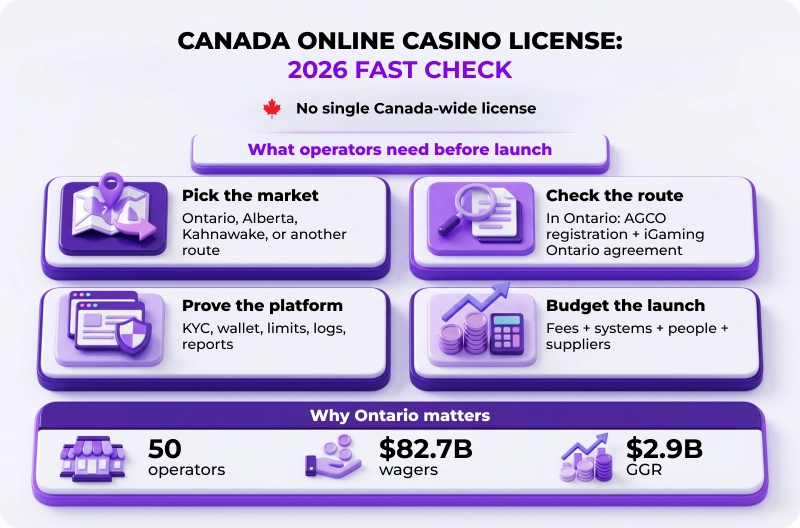
Main Licensing Route: AGCO Registration and iGaming Ontario Agreement
In Ontario, private operators need AGCO registration and an operating agreement with iGaming Ontario before serving players in the regulated market.
That differs from a Kahnawà:ke license under the Mohawk Territory of Kahnawake and from a supplier-side B2B gaming license. The Alcohol and Gaming Commission of Ontario states that operators must register to operate a regulated iGaming site, while iGaming Ontario says operators must take steps with both organizations before serving Ontario players.
A practical Ontario plan should include:
- AGCO operator registration.
- iGaming Ontario agreement workflow.
- Ownership and key-person disclosures.
- Financial source and control records.
- Clear scope of gaming activities.
- Registrar’s Standards compliance.
- KYC, AML, wallet, reporting, responsible gambling, security, and game-session evidence.
The main risk is treating this as paperwork only. iGaming Ontario’s role includes operating agreements, revenue reconciliation, market integration, responsible gambling requirements, AML program oversight, and customer dispute processes. Those duties translate into platform functions: verified accounts, traceable funds, controlled supplier access, limit enforcement, and exportable reports. Regulatory bodies expect operational proof, so these systems should be in place before operators start an online gambling business in Canada.
How Licensing Works Outside Ontario
The rest of Canada does not follow one shared private-operator model. In many provinces, online casino access is handled through a provincial lottery or Crown corporation. British Columbia’s government says BCLC manages all commercial gambling for the province, including online gambling, while Loto-Québec states that lotoquebec.com is Québec’s only legal gaming website. That makes the market-entry question different from Ontario.
Before planning a launch outside Ontario, check:
- Is there a direct private-operator licensing route?
- Is the market controlled by a provincial lottery corporation?
- Can suppliers work through a B2B or content partnership?
- Are casino games, poker, sportsbook, and lottery treated separately?
- What reports, limits, payment records, and player checks must the platform support?
Alberta is the exception operators should monitor closely. The province’s official iGaming fact sheet says the framework is moving toward a private, regulated iGaming market, with operators registering with AGLC and more detailed requirements set out in AGLC standards. The business consequence is simple: outside Ontario, market entry may depend on a public operator, a supplier relationship, or an emerging licensing process. A platform should be ready to separate provinces by rules, products, payments, and reports.
What Documents and Checks Does an Operator Need?
The application file must show that the operator can run the business safely and under control. Regulators look at ownership, decision-making power, funding sources, player checks, and the systems used to record activity. This makes online applications different from land-based casinos and from a supplier-side B2B gaming license, because the operator is responsible for every account, payment, game session, and report inside the gaming site.
The main evidence usually includes:
- Company ownership and structure.
- Directors, officers, and control persons.
- Documents showing where funds come from.
- Business plan and operating model.
- Approved gaming activities and product scope.
- Supplier and game provider information.
- AML, KYC, responsible gambling, and player protection policies.
- Hosting, cybersecurity, reporting, and audit-log records.
For Ontario, AGCO says applicant corporations and corporate shareholders, including parent or holding corporations, must complete entity disclosure when they hold 5% or more of any shares. For gaming companies, that turns a Canadian gambling license into a structured evidence file. Before operators apply for a license or start an online casino business, their Canada market-entry plan should prove who controls the platform.
What Your Platform Must Prove Before Obtaining a Gambling License in Canada
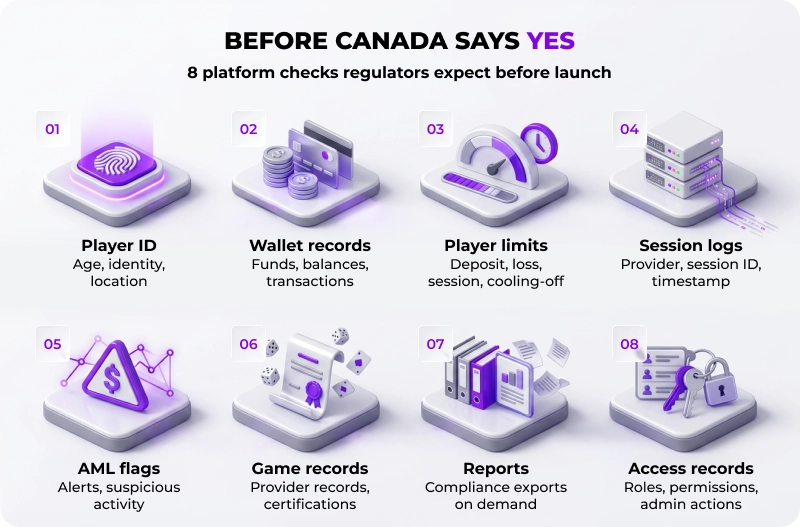
The legal file shows who owns the business, but the online casino software shows how the business will actually run. In Ontario, AGCO’s standards are risk-based and outcome-focused, meaning operators are expected to show effective player-protection processes before going live. A gaming authority will care about the real operation of a gaming site, not only the documents behind it.
The platform should be able to prove:
- Player registration, age, identity, and location checks.
- Wallet separation, transaction history, and balance records.
- Deposit, loss, session, and cooling-off limits.
- Game-session logs with provider and timestamp data.
- AML alerts and suspicious activity workflows.
- Provider-level game records and certification evidence.
- Reporting exports for compliance review.
- Security roles, access permissions, and admin actions.
This is where the gaming industry difference becomes clear. A Kahnawake gambling license, an Ontario setup, and another provincial model may require different proof of player eligibility, funds movement, and reporting. AGCO says its Registrar has authority to set standards for gaming sites, lottery schemes, related businesses, and related goods or services. Operators should make responsible gambling practices visible inside the platform before launch. That way, compliance teams can prove limits, exclusions, player-risk reviews, as well as reporting actions without rebuilding the system after approval.
How Much Does an Online Casino License in Canada Cost?
AGCO lists the Ontario internet gaming operator fee at CAD 100,000 per gaming site, per year, and its operator guide states that this regulatory fee must be submitted with the application. This verified fee applies to Ontario’s regulated iGaming operator registration. Because other provinces may use lottery-led, supplier-led, or developing market models, operators should request fee confirmation from the relevant provincial authority or conduct-and-manage entity before building a Canada budget.
| Expense Area | What It Covers | Why Operators Should Budget for It |
|---|---|---|
| AGCO fee | CAD 100,000 per gaming site, per year in Ontario | Regulator fee only; not the full launch cost |
| Legal support | Application, ownership checks, agreements | Weak files can delay approval |
| Compliance | AML, KYC, responsible gambling, policies | Compliance processes must work, not merely exist |
| Platform setup | Accounts, wallet, bonuses, reports, admin roles | Weak setup can force rework |
| Game aggregation | Providers, game access, supplier records | Supplier gaps can delay launch |
| Payments | Deposits, withdrawals, limits, reconciliation | Payment records support AML and reporting |
| KYC/AML tools | Identity, age, location, risk alerts | Weak checks create compliance risk |
| Hosting/security | Servers, access, data protection, uptime | The site must run securely and reliably |
| Testing | System, game, payment checks | Missing checks can delay go-live |
| Local operations | Support, finance, complaints, reporting | The business still needs daily management after approval |
Ontario’s CAD 100,000 fee should not be read as the total cost of launching. It is only the regulator-side fee for the gaming site. The real launch budget also includes people, systems, provider setup, payment integrations, testing, compliance checks, and ongoing operations. With NuxGame, the goal is to reduce separate build work by connecting casino management, game aggregation, payments, bonuses, KYC, AML, and reporting inside one operating system.
Ontario vs Alberta vs Kahnawake: Which Route Fits the Operator
Operators should not compare Canada licensing routes as if they all solve the same problem. Ontario, Alberta, and Kahnawake represent different market-entry situations. One is already operational for private operators, one is developing, and one is a separate long-standing licensing framework. The right choice depends on target market, product scope, regulator relationship, and platform requirements.
| Licensing Option | What It Means Now | What Operators Must Check | What the Platform Must Support |
|---|---|---|---|
| Ontario | Active regulated market for private operators | AGCO registration and iGaming Ontario agreement | Ontario rules for KYC, wallet, limits, reports, and suppliers |
| Alberta | Emerging framework to monitor in 2026 | AGLC rules, iGaming Alberta process, product scope, and launch timing | Configurable rules instead of copying Ontario setup |
| Kahnawake | Separate interactive gaming framework | Correct KGC permit, hosting model, and target-market legality | Separate setup; not a replacement for Ontario or provincial access |
The first licensing decision in Canada is the market you want to enter. Ontario means AGCO registration, iGaming Ontario onboarding, wallet records, limits, and reporting. Other provinces may require working through a provincial lottery, a local partner, or a supplier agreement. If you choose the platform before the license model, you may buy a very expensive suitcase packed for the wrong airport.

Denis Kosinsky
Chief Product Officer at NuxGame
The main risk is choosing a licensing option before knowing what it actually allows. Ontario can fit operators targeting a defined regulated provincial market. Alberta may become relevant as its iGaming framework develops. Kahnawake can support a separate licensing strategy, but it does not replace provincial access where a province requires its own model. To launch an online casino in Canada, operators need a platform that can separate market rules. NuxGame planning can support this by helping teams structure player checks, wallet flows, game access, reporting, and compliance workflows by market instead of forcing one static Canada setup.
Step-by-Step Licensing Process for Operators
Licensing starts with where you want to operate and ends with how the site will run. iGaming regulations require the operator to show who owns the business, what products will be offered, which suppliers are connected, as well as how the gaming platform will manage players, payments, risk, and reports. iGaming Ontario states that private operators must complete AGCO registration and an iGO operating agreement before serving players.
A clean workflow looks like this:
- Pick the province, territory, or licensing route.
- Confirm product scope and allowed verticals.
- Prepare ownership, funding, and management records.
- Select platform, payment, KYC, AML, and game suppliers.
- Build responsible gambling and player protection features.
- Prepare audit logs, reporting exports, and system evidence.
- Submit the regulator application.
- Complete legal, compliance, and technical follow-ups.
- Execute the operating agreement where required.
- Go live with monitoring, reporting, and incident handling.
This order reduces avoidable rework for online gambling sites. If teams start design before checking what the operator is required to prove, they may rebuild wallet logic, reports, or supplier permissions later. Disciplined online casino development helps operators prepare for Ontario’s iGaming market and adapt the same control logic to other approved routes.
Common Mistakes That Delay Canadian Market Entry
Canadian market entry usually slows down when the commercial plan moves faster than the compliance plan. Teams may create an online gaming site, select providers, and prepare campaigns before confirming where online gambling is legal and which authority manages access. That order creates risk because AGCO says operators are expected to make sure standards related to site operation are met, regardless of who performs the activity.
Operators should avoid:
- Treating Canada as one licensing route.
- Skipping province-by-province rule checks.
- Choosing suppliers without regulatory review.
- Weak KYC, AML, and player-risk processes.
- Unclear deposit, loss, or session limits.
- Missing audit logs for admin actions.
- Reports that cannot be exported cleanly.
- Advertising before compliance approval.
These are not small admin issues. They can delay launch, create payment review problems, trigger regulator questions, or damage market trust. In the iGaming industry, AML for gaming should connect identity checks, wallet records, transaction monitoring, and risk review. NuxGame supports this through structured platform readiness: connected player checks, wallet records, supplier permissions, audit logs, and reporting.
Bottom Line: Where Licensing and Platform Architecture Connect
A license application becomes more expensive when the platform gap appears late. If player accounts, wallet records, supplier access, responsible gambling features, risk alerts, and reports are not ready, the operator may need rework during review instead of moving toward launch. This is why platform planning should happen before the application becomes a legal and technical bottleneck.
A regulated setup needs more than game content; it needs payment and wallet logic, bonus rules, risk workflows, operational dashboards, and jurisdiction-based configuration. NuxGame supports operators preparing for regulated market entry with an iGaming software platform built around aggregation, account management, payments, reporting, and compliance-ready controls.
Contact NuxGame to discuss the platform structure needed for your target market.