Русский
 iGaming in Latin America 2026: Compliance-First Guide to Regulation, PIX, and Geo-Fencing

iGaming in Latin America is not one market with one rulebook. Brazil hosts bettor data on Brazilian soil and verifies faces before the first deposit. Argentina authorises operators one district at a time. Chile authorises nobody. A federal permit in Brazil costs R$30 million for five years, covers three brands, and grants zero rights across the region.
Entry fails on infrastructure far more often than on paperwork. Server localization, a national identity feed, and a local payment system are launch-gating dependencies, not post-launch tasks. The NuxGame platform absorbs that variance through per-market configuration of casino aggregation, payment routing, player account rules, and reporting, so the second GEO reuses the first build.
Key Takeaways
-
Rules in Brazil require bettor data in local data centres and a live SIGAP feed; a broken feed is a suspension event.
-
Peru taxes every stake at 1%, which consumes roughly a fifth of operator gross win at a 5% hold.
-
District-level regimes need a permit, a local bank account, and a geo-fence per silo.
-
Colombia changed its online gambling tax base three times in 13 months.
-
Vertical-scoped regimes force casino games to be gated at the catalogue layer, not hidden in the lobby.
The LATAM iGaming Regulatory Landscape in 2026: A Country-by-Country Ledger
iGaming regulation across Latin America follows no common template. Four Latin American countries now run a live regulated iGaming market, each built on a different legal theory. Brazil legislated federally under Law 14.790/2023. Colombia has run Coljuegos concessions since 2016. Peru opened in February 2024. Ecuador recognised sports betting only, from February 2026. Argentina delegates gambling regulation to its 23 provinces and the capital.
| GEO | Authority / instrument | Operator levy | Localization requirement | Domain | Identity gate |
|---|---|---|---|---|---|
| Brazil | SPA/MF — Law 14.790/2023, Portarias 722, 827, 1.143, 1.231 | 13% of GGR (12% to Mar 2026, 15% by 2028) plus IRPJ, CSLL, PIS/COFINS | Betting system and bettor data in Brazilian data centres; abroad only under bilateral treaty with LGPD observed | .bet.br, one label per brand | CPF name-match plus Face Match with liveness |
| Colombia | Coljuegos concession contracts | 15% exploitation rights; 16% deposit levy under the March 2026 decree, VAT position in litigation | Local entity; systems connected for supervision | Local entity required | Verified identity, AML officer mandated |
| Peru | MINCETUR (DGJCMT) — Law 31557 / 31806 | 12% of net win less 2% maintenance (~11.76% effective) plus 1% ISC per stake | Certified transmission to the ministry data centre over SFTP | Local presence required | Registered identity, crypto prohibited |
| Ecuador | Ministry of Sports / SRI | 15% income tax on gross win plus 15% VAT; annual fee of 655 SBU (~US$307,850) | Tax duty follows user location, not platform domicile | — | Vertical-scoped: sports betting only |
| Argentina | LOTBA, IPLyC BA, provincial lotteries | 25% in the capital; district rates vary; 5% federal indirect tax | Player funds held in a bank account in the authorising district | .bet.ar via NIC.ar | RENAPER validation plus geolocation |
No single permit opens the region. Market entry sequencing beats paperwork here, because local banking, lab certification, and the data feed usually set the launch date long before an authority signs anything. Teams tracking the LATAM iGaming market should design for configuration reuse from the first integration, not the third
Brazil 2026: Technical Compliance for the Regulated Market Boom
Roughly 87 authorisations were active by mid-2026, and the grace period has closed. Licensed operators produced 7.28 billion in the first half of 2026, up 83% year on year. Industry groups estimate the effective burden, including corporate taxation, approaches 50% — among the heaviest in the iGaming industry.
Localization is written into Portaria 722/2024. The betting system and bettor records must sit in data centres inside the country, with offshore hosting allowed only where a bilateral cooperation treaty exists and LGPD duties are met. Information security follows ISO 27001 under Decree 11.870/2023, which pushes most builds onto regional cloud infrastructure in São Paulo. RNG and online casino games require certification by locally appointed labs.
SIGAP: The Fiscal Transparency Pipeline
SIGAP is a mandatory back-end connection, not a reporting portal. Operators transmit wagers, settlements, deposits, withdrawals, bonuses, and identity records, with high-risk categories moving on near-real-time cycles. In August 2026 the regulator imposed precautionary measures on authorised brands over transmission failures. Feed continuity belongs in production alerting, not on a compliance calendar reviewed monthly.
KYC via CPF and Biometric Face Match
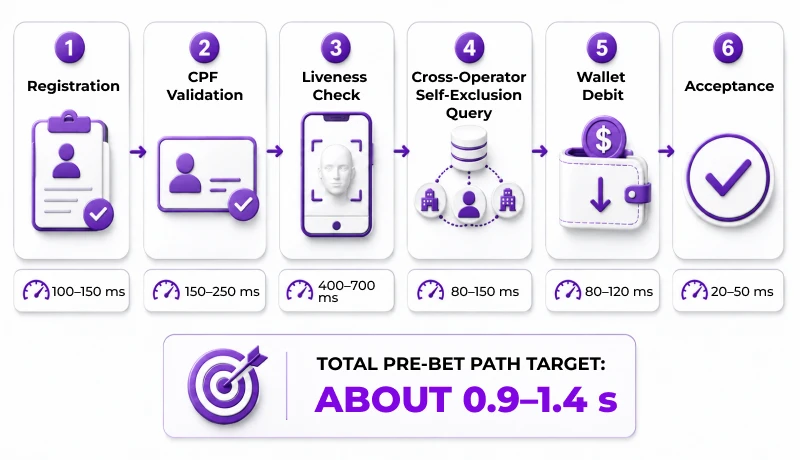
Onboarding runs three checks in sequence: real-time CPF validity and name-match against Receita Federal data, facial biometrics with liveness detection before the first deposit clears, then 1:N deduplication enforcing one active account per CPF per brand. Biometric enrolment at this depth is ahead of most global iGaming frameworks. Event logging follows the discipline set by the remote technical standards, where player protection duties and audit trails are tested together.
Argentina Provincial Licensing: Implementing Multi-Silo Geo-Fencing
Twenty-three districts plus the City of Buenos Aires authorise operators independently, and each silo carries its own permit, tax rate, certification lab, and reporting endpoint. LOTBA has closed new permits, so entry now runs through acquisition or a deal between local and international groups. Buenos Aires Province granted 15-year permits by tender. Santiago del Estero bans online betting outright.
Operators budget for the license and forget the second invoice: the rebuild. Argentina can mean a separate rulebook for every district you enter, under one brand. We tell clients to treat market configuration as a product feature, not a legal afterthought. Teams that do this launch their third market faster than their first.

Denis Kosinsky
Chief Product Officer at NuxGame
Geo-fencing here is silo-level, not country-level. Access binds a player to the authority that issued the permit, validated through RENAPER identity data plus IP and device geolocation. Each silo needs its own wallet ledger, local bank account, tax filing, and .bet.ar label from NIC.ar. ENACOM-coordinated blocking of unlicensed online platforms makes the fence enforceable rather than decorative.
Colombia and Peru: How the Tax Base Rewrites the Product
Colombia shows how fast a base moves. A 19% VAT on player deposits arrived in February 2025; sector contributions then fell 46.6% year on year by July. A December 2025 decree shifted VAT to gross win, the Constitutional Court suspended it in January 2026, and a March 2026 decree reintroduced a 16% deposit levy. Three bases in 13 months.
Peru taxes turnover instead, and the sports betting market absorbs that directly at the margin line. The regulator there created a dedicated online directorate in 2025, so supervision has tightened alongside the tax. Where a regime authorises one vertical only, catalogue scope becomes a control rather than a merchandising choice.
- Deposit-based tax — model cash-in, not margin; bonus churn becomes a fiscal event.
- Stake-based tax — at a 5% hold, 1% of turnover equals about a fifth of gross win.
- Vertical-scoped permit — the online casino segment stays dark while online betting and gaming run side by side elsewhere.
Payment Systems in Latin America: The Entry Bottleneck
Payment design in Brazil is prescriptive. Permitted payment methods are PIX, TED, debit, and prepaid instruments; credit cards and cryptocurrency are barred. The payment account must belong to the registered bettor, which forces an ownership check into the withdrawal path. Cardholder data scope still falls under PCI DSS v4 requirements, so European certification generally carries over.
PIX and Local Gateway Integration
PIX settles in seconds, which resets expectations: withdrawals get judged in minutes, not banking days. Build for provider failover, retry cascades, and reconciliation against local settlement files. Player preferences in Latin America are mobile-first — most active players fund accounts from mobile devices — so QR and deep-link flows carry the conversion, not the desktop cashier.
- Colombia — PSE bank transfers, plus Nequi and Daviplata wallets.
- Peru — Yape and Plin for low-value deposits; cash networks matter outside Lima.
- Argentina — bank transfer and Mercado Pago, with strict player-name matching.
Payment approval rate, not deposit volume, is the metric worth instrumenting from day one
Chile: Building Before the Country Moves to Regulate Online Gambling
Bill 14838-03 sits in its second Senate reading after receiving top legislative urgency in May 2026. A November 2025 Supreme Court ruling ordered ISPs to block unauthorised sites, confirming that only the state monopoly holders — Polla Chilena, Lotería de Concepción, and Teletrak for horse races — may take bets online. Regulation of online betting has stalled there for four years.
Tax authority Resolution 69/2026 then opened VAT registration to offshore platforms without conferring legal status. Paying tax does not create a permit. Unlike the rest of Latin America, Chile still has no licensing path, so the practical posture is readiness — language, rails, localisation — with acquisition spend parked. Land-based casinos remain the only authorised gambling market on the ground, and other forms of gambling stay closed.
Entry Routes: Local, International, or B2B Cover
Three routes exist and usually combine. A local license is mandatory in regulated markets in Latin America, and district regimes require one per territory. An international license serves .com traffic elsewhere and typically bridges the 8-to-14-month local application window. A B2B license covers the supplier side, which international operators often overlook until an authority asks for it.
Comparative reading on each option, with fees, timelines, and technical duties:
- Curaçao — CGA review phases, fees, and supplier deadlines
- Anjouan — fast approvals and crypto-friendly terms
- Malta — Type 1–4 classes and audit expectations
- Isle of Man — on-island servers and player fund segregation
- Kahnawake and Tobique — requirements and costs
- Costa Rica — why it is not a license in the usual sense
- B2B cover, an overview of options, a cost breakdown, and the application process
Reputation transfers even where rights do not. Supervisors and banking partners read a Malta Gaming Authority file as evidence of tested controls, which shortens due diligence for foreign operators entering a new jurisdiction. US-based groups running sweepstakes software often treat the region as their first real-money step, serving online casinos and sports betting from one back office.
Technical Module: Regulatory Checklist for 5 Major LatAm GEOs (2026 Edition)
| GEO | Launch-gating dependency | Data feed | Identity gate | Payment constraint | Fail state |
|---|---|---|---|---|---|
| Brazil | Local entity, 20% local shareholding, in-country hosting, ISO 27001 scope | Live SIGAP connection, near-real-time for high-risk events | CPF match plus liveness before first deposit | PIX, TED, debit, prepaid only; account in bettor's name | Feed discontinuity triggers precautionary measures |
| Argentina | Separate permit per district, local bank account per silo | Reporting endpoint per authorising body | RENAPER validation plus session geolocation | Player-name matching on transfers | Cross-silo access breaks the fence |
| Colombia | Concession contract, AML officer appointed | Supervisory reporting link | Verified identity, self-exclusion tools | Deposit-level levy changes cash-in economics | Tax base shifts mid-year |
| Peru | Guarantee of 600 UIT, platform homologation | Certified SFTP transmission to the ministry | Registered identity, crypto blocked | 1% ISC applies per stake | Failed test transmission blocks go-live |
| Chile | No license available; readiness build only | None until the bill passes | Prepare RENAPER-equivalent flows | VAT registration without legal status | Acquisition spend before enactment |
The Future of iGaming in Latin America: Making the Entry Decision
Latin America offers scale, not simplicity. Brazil carries high capital and localization cost and remains the largest market in the region. Peru pairs a stable rulebook with a turnover tax that punishes thin-margin sportsbooks. Colombia offers a mature framework with unstable taxation. District-level markets offer depth priced in repetition. Chile offers patience.
The right question is not which market is largest. It is which GEO the current stack can serve without a rebuild, and how much of that build survives into the next two entries. Sustainable growth across Latin America comes from configuration reuse, not from repeated greenfield projects.
Mapping your next GEO? The NuxGame team supports operators with turnkey deployment, sportsbook and online casino delivery, AML and KYC tooling, payment routing, and legal services covering permit selection and compliance reporting. Bring your target list, and the team will map it against certification, hosting, and reporting gates before capital is committed.