RNG in iGaming 2026: Technical Controls Behind Fair Casino Outcomes
RNG in iGaming is the technical system that turns random numbers into casino results across slots, roulette, poker, and table games. It does not only support the visible game outcome. It also connects to game math, RTP mapping, wallet settlement, audit records, and certification evidence. In regulated markets, this makes random number generation part of the platform’s compliance and infrastructure layer, not just a fairness term in product copy.
For operators, this matters because every new provider, game version, and target jurisdiction adds a responsibility: the team must confirm what was certified, how outcomes are mapped, how wallet events are reconciled, and what evidence is available for regulators, partners, or player disputes. NuxGame helps manage the platform layer around certified provider content through casino aggregation, provider routing, wallet synchronization, reporting, and back-office controls. This guide explains how the system works and what operators should check before adding randomized content to an online casino platform.
Key Takeaways
What RNG Actually Controls in a Casino Platform
RNG means random number generator, but that phrase understates its operational role. In online games and casinos, RNGs create values that casino game logic converts into visible events. The same pipeline can support a slot machine, a roulette wheel position, a card order, or a table games result.
The random number generator does not decide the business model of a game alone. It provides random values, while the game math layer applies reels, paytables, volatility, and RTP rules. That separation matters because a game outcome can be random and fair while still following a fixed mathematical return model.
For operators, RNG belongs in technical due diligence, not only product copy. RNGs need to confirm that each game round starts from an independent input and that the result can be connected to the right session, provider response, wallet transaction, and audit record. These controls help prepare compliance files, investigate disputes, and avoid launching content outside the approved scope.
NuxGame supports the platform side of this process around certified provider content. Through casino aggregation, wallet synchronization, reporting, and back-office review tools, operators can manage game rounds, transactions, provider references, and operational evidence in one environment.
TRNG vs PRNG: Hardware Randomness and Algorithmic Seeding
A true randomization model uses entropy from physical processes. Examples include electrical noise, photon behavior, thermal variation, or radioactive decay. True random number generators are valuable where hardware entropy is required, but they introduce device management, throughput planning, and field-environment testing requirements.
Most online casino games use pseudo-random number generators because they produce high-speed, testable output from an algorithm. A PRNG starts with a seed number and then produces a sequence of numbers. If the initial seed number is protected correctly, the following new number remains impractical to predict.
A cryptographically secure PRNG, or CSPRNG, adds stronger resistance against state prediction. It is different from a general simulation randomization system such as the Mersenne Twister algorithm, which is known for long period and equidistribution but is not designed as a cryptographic primitive. Casino systems need the randomization model documented before lab review and deployment.
GLI-19 Compliance and RNG Certification
GLI-19 is an important benchmark for interactive gaming systems because it covers system controls around online gambling operations. For RNGs work, the value is not only the certificate. The value is the evidence chain around software versions, technical setup, outcome generation, reporting, and operational controls.
Gaming Laboratories International also states that RNG testing submissions should include the hardware and software necessary to collect random data. It recommends running the RNG application on hardware identical to the field environment where possible. That requirement affects staging, release management, and infrastructure planning for casino operators.
RNG approval should confirm the approved scope. Operators need to know whether the certificate covers the generator, the casino game implementation, the math model, or a specific platform version. A generic certificate creates risk if the deployed game build, RNG algorithm, or result-mapping layer differs from the tested submission.
Mathematical Integrity: NIST, Dieharder, and Lattice Testing
Statistical testing checks whether output looks random under defined methods. NIST SP 800-22 is widely referenced for random and pseudorandom number generators, but NIST also notes that statistical tests do not replace cryptanalysis. This distinction matters when a randomization system appears random yet still contains design weaknesses.
Dieharder is another random number generator testing suite used to examine the randomization system rather than isolated files of random numbers. It helps identify output patterns, distribution problems, and unlikely sequence behavior. Passing one suite is not proof of perfection, but failed tests are strong indicators for rework.
Marsaglia’s lattice test and spectral test concepts remain relevant for older linear generators. They help reveal structure where points fall into planes instead of filling space properly. Technical teams do not need to teach this to players, but CTOs should expect labs to examine deeper mathematical integrity where the randomization model requires it.
RNG to RTP Mapping Engine
RNGs generate values, but RTP comes from the game math layer. A slot game with an RTP of 96% does not promise a player 96 units back from 100 units. RTP describes a long-run mathematical return over a large sample under the certified rules of that slot game.
The mapping stage converts raw random numbers into symbols, cards, wheel positions, or weighted events that determine the outcome. This is where fairness can fail if scaling logic introduces bias. The system must ensure fairness by preserving distribution from the output to the final casino result.
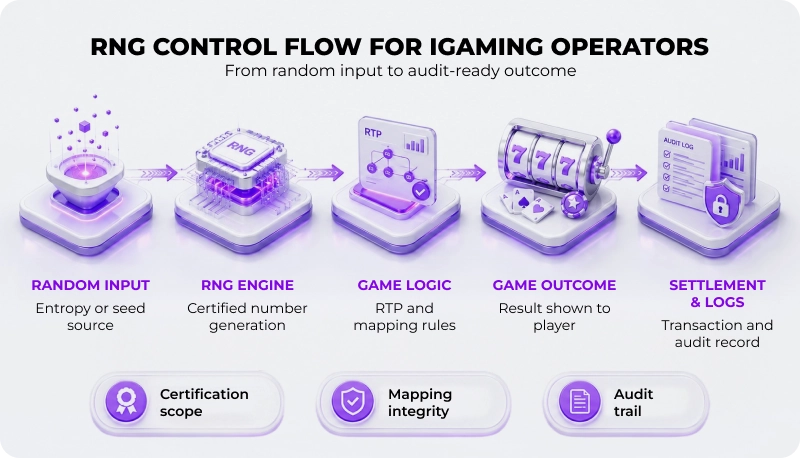
A certified RNG process must keep this chain controlled. RNGs must generate random numbers independently, while the mapping engine applies game rules. The platform then records the game round, wallet transaction, session state, provider response, and audit trail.
RNG Validation and Game Event Logging
RNG audits do not end when the lab issues a report. Operators need event-level records that connect the random input to the visible outcome and settlement. Useful logs include session ID, provider ID, game round ID, raw result reference, mapped result, wallet debit, wallet credit, timestamp, and callback status.
A practical monitoring target is p95 result-processing latency below 50ms between provider callback and platform acknowledgment. Another useful control is 99.9% availability for the logging pipeline that records regulated casino events. These are engineering targets, not universal legal requirements, but they help measure operational resilience.
Support teams should not see seed values, internal algorithm states, or sensitive RNG system logic. They need controlled evidence instead: certificate status, round history, provider reference, transaction alignment, and dispute notes. This protects systems while giving compliance and support teams enough transparency to investigate complaints.
Provider Integration and Operator Responsibility
Casino game providers usually operate the certified RNG for their own games. The platform layer receives callbacks, handles wallet synchronization, records events, and exposes operational reporting. NuxGame helps operators manage these dependencies through casino aggregation, payment configuration, player account tools, and back-office control.
Responsibility still remains shared. The provider proves the randomness of the game, while the operator proves that the approved game was launched correctly. The platform proves transaction flow, session continuity, reconciliation, and reporting integrity after every spin of a slot or other event.
| Layer | RNG responsibility | Operator risk if weak | Evidence to request |
|---|---|---|---|
| Game studio | Algorithm, math model, RTP, hit frequency | Unapproved or biased casino game release | Certificate, math sheet, game rules |
| Testing lab | Statistical testing and technical review | Rejected launch or repeat testing | Report, certification scope |
| Platform | API routing, wallet sync, session continuity | Missing settlement or unresolved dispute | Callback logs, reconciliation reports |
| Operator | Vendor approval and compliance files | License delay or audit issue | Approval register, release notes |
| Support team | Player explanation and escalation | Poor trust and complaint handling | Round records, provider references |
This split is especially important for online casinos with large content libraries. More game providers mean more certificates, APIs, game IDs, wallet events, and reporting formats. A platform layer reduces fragmentation by centralizing the operational evidence operators need during review.
RNG in iGaming is the technical system that turns random numbers into results across all kinds of games. Unpack RNG for iGaming: learn how random number generators work and ensure fair play in online casino games and slots, guaranteeing truly random outcomes.

Denis Kosinsky
Chief Product Officer at NuxGame
Compliance Architecture for the US and Regulated Markets
The US market does not have one single national online gaming RNG approval pathway. States define their own technical control requirements and usually rely on approved independent testing laboratories. Pennsylvania, for example, requires a cryptographically strong random number generator and recognized statistical testing with a 95% confidence level.
The UK Gambling Commission requires random number generation and game results to be acceptably random. Its RTS 7 guidance also prohibits adaptive behavior, meaning compensated game logic. That requirement has a direct architectural impact because the system must not alter output based on player losses, stake size, or prior wins.
The Malta Gaming Authority requires prior approval documentation when new games use an RNG that is not already approved. Requested materials can include certificates, technical setup documentation, gaming system specifications, and engine information. ISO/IEC 17025 matters here because it defines competence and impartiality requirements for testing laboratories, while ISO/IEC 27001 supports information security governance around systems, access, and change control.
Player Communication and Support Workflows
Casino players often believe a slot is cold, that the casino knows when they gamble, or that payouts change after a big win. Support teams need clear language that explains independence without overpromising outcomes. The message should say the game is fair because the certified process controls the result, not because wins are guaranteed.
Every spin remains independent in standard slot titles unless the game rules define approved persistent-state mechanics. A roulette result does not become due because previous results landed elsewhere. Online poker shuffling also depends on certified randomization, although table logic and player decisions create a different gaming experience from slots.
Responsible gambling communication should stay separate from fairness explanations. RNG ensures fair play at the result-generation layer, while responsible gambling tools manage player protection. Combining those topics too loosely creates confusion and weakens both compliance narratives.
Technical Snapshot
This snapshot gives CTOs, Product Managers, and Compliance Officers a launch checklist for RNG technology and supporting controls.
| Requirement | Technical checkpoint | Operational consequence |
|---|---|---|
| RNG approval | Certificate scope covers each game and version | Prevents uncertified content release |
| Generator type | PRNG, TRNG, or CSPRNG documented | Supports lab review and risk analysis |
| Seeding | Seed values protected from prediction | Reduces manipulation risk |
| Number generation | Output passes recognized statistical tests | Supports randomness validation |
| Mapping | Scaling preserves unbiased distribution | Protects fairness and randomness |
| RTP logic | Math model matches approved rules | Prevents return-profile drift |
| Logging | Result, wallet, and session data share trace IDs | Supports audit and disputes |
| Monitoring | Alerts cover callback failures and gaps | Reduces unresolved player issues |
| Change control | Build hashes and approvals are stored | Prevents software drift after certification |
| Security governance | Access and release controls documented | Supports ISO/IEC 27001-style evidence |
The technical risk is rarely one missing document. It is usually a broken chain between certification, deployment, monitoring, and reporting. NuxGame helps operators reduce that gap by managing platform-side aggregation, wallet flows, provider routing, and back-office records in one operational environment.
Bottom Line
RNG in iGaming is a compliance and infrastructure control, not only a fairness concept. Operators need certified content, statistical validity, approval records, audit logs, wallet reconciliation, and support-ready evidence before traffic starts. If your team is preparing a casino launch, provider migration, or RNG-based content expansion, NuxGame helps structure the platform layer around aggregation, wallet flows, reporting, provider routing, and back-office control. Contact NuxGame to review the technical setup required before adding certified casino content.